Arrowheads: The Complete Guide to Native American Points
Arrowheads are the most recognized artifacts of ancient North America. Farmers turn them up in plowed fields, kids find them in creek beds and families pass them down for generations. Each one was shaped by hand from stone, sometimes thousands of years ago, by people who depended on it to feed their families.
This guide covers what arrowheads are, how old they are, what they were made from, how to identify the type you have, how to tell real from fake and what they may be worth. Whether you just found your first point or inherited a lifetime collection, you will know where you stand by the end.
What Is an Arrowhead?
An arrowhead is a pointed tip, usually chipped from stone, that was attached to the front of an arrow shaft. Archaeologists use a broader term, projectile point , because most of the "arrowheads" people find were never on arrows at all.
For most of human history in the Americas, hunters used spears and the atlatl, a spear-thrower that launched long darts with great force. The bow and arrow arrived much later. In much of eastern North America it became common only around 1,500 years ago. That means a large point several inches long is almost always a spear or dart point, while the small, light points under about an inch and a half are the true arrowheads.
Collectors still call all of them arrowheads, and that is fine. Knowing the difference simply helps you date what you have. Large, older points often belonged to dart hunters using the atlatl, the same tool connected to bannerstones and atlatl hooks and weights.
How Old Are Arrowheads?
Stone points span more than 13,000 years of North American history. Researchers group them into broad time periods. Dates vary by region and by source, so treat these as general ranges.
- Paleo-Indian period (about 13,500 to 10,000 years ago): The earliest Americans hunted mammoth, mastodon and ancient bison. Their points, such as Clovis and Folsom, are often fluted, with a long channel flake removed from the base. These are among the most sought-after artifacts in the world.
- Archaic period (about 10,000 to 3,000 years ago): As the climate warmed and big game disappeared, people hunted deer and smaller animals and gathered more plant foods. Points became more varied, with side notches, corner notches and stems. Kirk, Hardaway and Morrow Mountain points come from this era.
- Woodland period (about 3,000 to 1,000 years ago): Pottery, mound building and settled villages spread across the East. Adena and Hopewell cultures made fine stemmed and notched points, and the bow and arrow came into wide use late in this period.
- Mississippian and Late Prehistoric period (about 1,100 to 400 years ago): Large towns such as Cahokia flourished. Most points from this time are small triangular arrowheads, light enough for a fast arrow.
For a deeper look at how these periods fit together, see our article on North American time periods.
What Were Arrowheads Made Of?
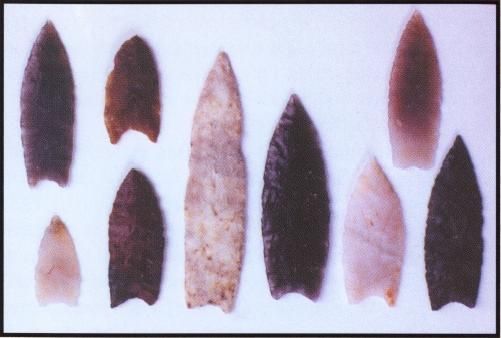
Ancient toolmakers chose stone that breaks in a smooth, predictable way, called a conchoidal fracture. The best material was fine-grained and free of cracks. Common materials include:
- Flint and chert: The most widely used materials in North America. Chert comes in nearly every color, from gray and black to red, yellow and banded. Specific sources such as Dover, Flint Ridge and Burlington chert can sometimes be recognized by color and texture. Learn more in Flint and Chert: A Chemical Form.
- Obsidian: Natural volcanic glass, mostly found in the West. It produces razor-sharp edges and is prized by collectors.
- Quartz and quartzite: Common in the Southeast and Appalachians. Quartz is harder to work, so quartz points often look rougher, but well-made examples are highly valued.
- Jasper, chalcedony and agate: Colorful, glassy stones that make some of the most attractive points.
- Novaculite, rhyolite and basalt: Regional materials, such as Arkansas novaculite or rhyolite in the Carolinas.
Material matters for both identification and value. A point made from a rare or colorful stone, or from a material that traveled hundreds of miles from its source, often draws more interest than the same shape in common local chert.
How Were Arrowheads Made?
The process is called flintknapping . A knapper started with a nodule or flake of stone and struck it with a hammerstone or a billet of antler or hardwood to rough out a shape. This is percussion flaking, and it leaves broad, shallow scars.
Next came pressure flaking. Using the tip of an antler tine, the knapper pressed small flakes off the edges to thin and sharpen the point. Finally, notches or a stem were added so the point could be bound to a shaft with sinew and plant pitch. Many points were resharpened again and again until they were too small to use, which is why the same type can appear in many sizes.
Reading these flake scars is one of the best ways to judge authenticity. Ancient flaking shows patterns, wear and weathering that are very hard to fake.
Types of Arrowheads
More than a thousand named point types are recognized in North America. Each type has a typical shape, base, notching style, size range, time period and region. A few of the best-known types:
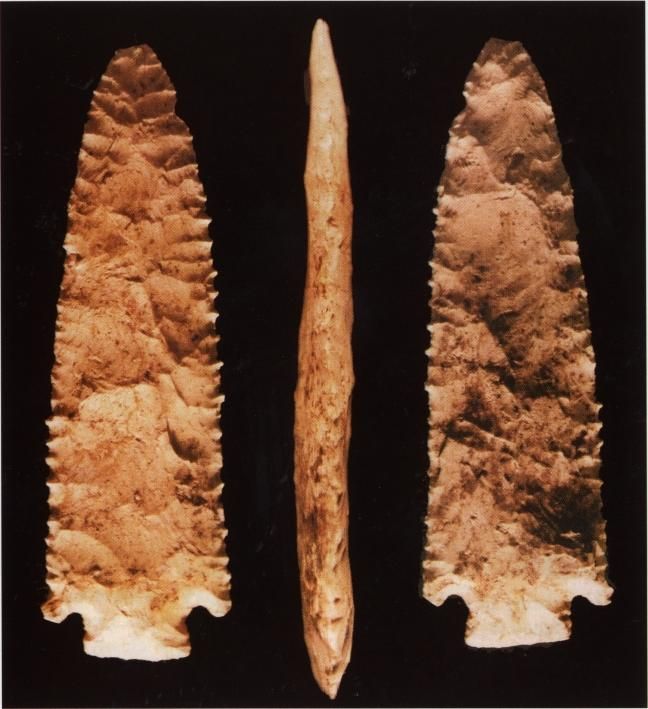
- Clovis: The classic Paleo-Indian point, lanceolate in shape with flutes on both faces and a ground base. Clovis points date to about 13,000 years ago and are found across the continent. See authentic Clovis points in private and museum collections.
- Folsom: A thin, finely made Paleo point with a flute running nearly the full length, associated with ancient bison hunting on the Plains. Read about the Folsom culture.
- Dalton: A late Paleo to early Archaic point, often serrated and beveled, common in the Midwest and Southeast.
- Kirk: An Early Archaic corner-notched point, frequently serrated, found widely in the East.
- Morrow Mountain: A Middle Archaic point with a short, contracting stem, common in the Carolinas and the Southeast.
- Adena: A Woodland stemmed point with a rounded base, tied to the Adena mound-building culture of the Ohio Valley.
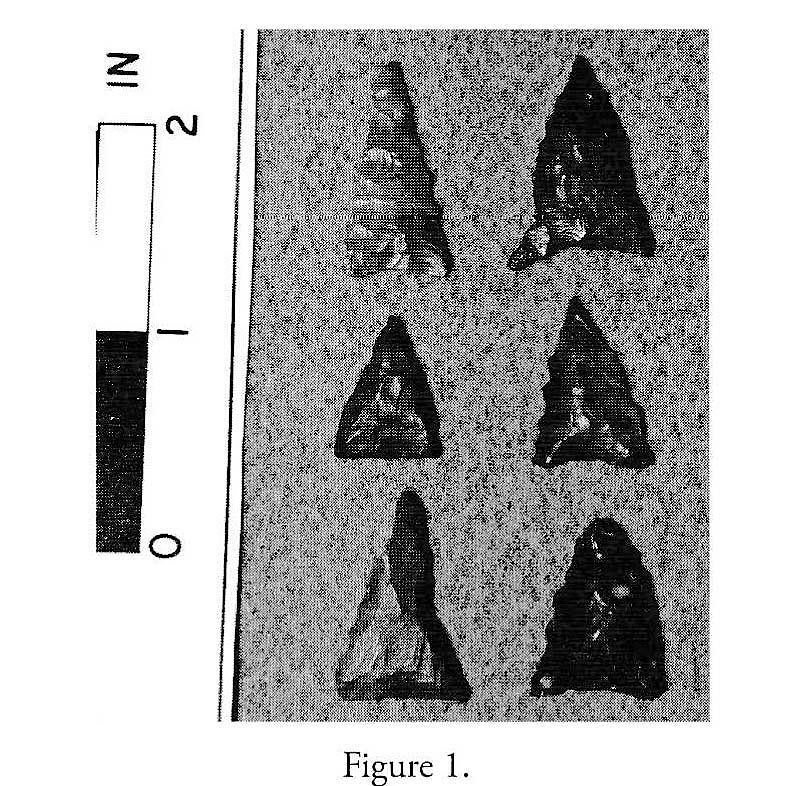
- Bird points: Small Late Prehistoric arrowheads. Despite the name, they were used on all kinds of game. Read a theory on the usage of bird points.
Browse more examples in our gallery of Paleo points.
How to Identify Your Arrowhead
Identifying a point is a process of narrowing it down. Work through these steps:
- Note where it was found. The state, and if possible the county, is the single most useful clue. Many types are regional.
- Measure it. Length and width help separate dart points from true arrowheads and one type from another.
- Look at the base and notches. Is it side-notched, corner-notched, stemmed, fluted or a plain triangle? Is the base straight, concave, convex or eared?
- Check the material. Note the color and any banding, and whether it is glassy or grainy.
- Look at the flaking. Parallel flaking, serrated edges and basal grinding all point toward particular types and periods.
- Compare against a reference. Our Arrowhead Identification Database showcases more than 1,000 point types and 60,000 photographs from the Official Overstreet Indian Arrowheads Identification and Price Guide, searchable by region, shape and name.
Still not sure? Send us clear photos of both sides on a plain background with a ruler for scale. Our free first look will tell you what you have.
How to Tell If an Arrowhead Is Real
Reproductions are common, and some are made specifically to fool buyers. These are the main things experienced collectors look for:
- Patina and weathering: Stone that has been in the ground for thousands of years develops a surface change. Fresh, shiny flake scars on a point that should be ancient are a warning sign.
- Mineral deposits: Real points often carry root etching or mineral staining that follows the flake scars and sits in tiny cracks.
- Consistent wear: Edges, ridges and the base should show wear that matches how the point was used and hafted.
- Flaking style: Each type has a characteristic flaking pattern. Modern knappers often leave flaking that is too uniform or that does not match the type.
- Too perfect: An unusually large, flawless point in a rare type deserves a closer look before any money changes hands.
For a full walkthrough, read How to Tell If Your Arrowheads Are Real. For valuable pieces, an independent authenticator and a certificate of authenticity are worth the cost.
How Much Are Arrowheads Worth?
Most arrowheads are worth less than people hope, and a few are worth far more than anyone would guess. Common, broken or field-worn points often sell for a few dollars each. Complete, well-made points of popular types can bring tens to hundreds of dollars. Exceptional Paleo points with strong documentation can reach thousands, and the rarest pieces sell for much more.
The factors that drive value:
- Type and age: Paleo-Indian points such as Clovis and Folsom lead the market.
- Size: Larger examples of a type are usually worth more.
- Condition: Breaks, nicks and resharpening lower value. Restored points are worth much less than untouched ones.
- Material: Colorful or rare stone adds interest.
- Workmanship: Thin, symmetrical, finely flaked points command a premium.
- Provenance: Knowing who found it, where and when, and who has owned it since, can make a large difference.
- Authentication: A respected certificate of authenticity supports higher prices for significant pieces.
Read more in How to Determine the Value of Your Arrowheads, or send photos for a free first look. If you are ready to sell, see We Buy Arrowheads.
Where to Find Arrowheads
Ancient people camped near water, so the best places to look are often near rivers and creeks, on high ground above floodplains and where streams meet. The most productive spots for finding points on the surface include:
- Plowed fields after a rain: Rain washes the soil off artifacts and makes them easier to spot.
- Creek beds and gravel bars: Moving water exposes and concentrates stone artifacts.
- Eroded banks and washouts: Erosion can reveal artifacts that were buried for centuries.
Look for the shine of chert, unusual colors and the regular, scalloped edges of worked stone. Experienced hunters train their eyes to spot a single straight edge or a notch among thousands of ordinary rocks.
Collecting Arrowheads Legally and Ethically
Before you look, know the rules. In general:
- Always get permission on private land. Artifacts belong to the landowner.
- Do not collect on federal or tribal land. The Archaeological Resources Protection Act makes it illegal to dig up or remove artifacts from federal and tribal lands without a permit.
- Never disturb graves. Burials and associated objects are protected by federal law, including NAGPRA, and by state law.
- Check your state's laws. Rules for state land, riverbeds and lake shores vary widely.
Our guides to federal and state regulations and Indian artifact collection laws explain the details. Arrowheads.com only works with artifacts that were legally obtained.
Caring for and Displaying Arrowheads
Handle points by the edges and avoid cleaning them with harsh chemicals or wire brushes, which can strip patina and lower value. A gentle rinse in plain water is usually enough. Display points in a closed case or frame to keep them safe and dust-free, and label each one with where and when it was found. That information is part of the artifact's story, and it adds value when the collection is passed on or sold.
Inherited a collection and not sure what to do? Read What to Do with Inherited Arrowheads.
Arrowhead FAQs
Are arrowheads worth money?
Some are. Common and broken points usually have modest value, while complete, well-made points of desirable types can be worth hundreds or more. Paleo points with good documentation are the most valuable.
How old is the average arrowhead?
Most surface finds are between about 1,000 and 10,000 years old. Small triangular arrowheads are usually the youngest, and fluted Paleo points are the oldest, at more than 12,000 years.
What is the difference between an arrowhead and a spear point?
Size and weight. True arrowheads are small and light, usually under about an inch and a half, because they had to fly on a slender arrow. Larger points were made for spears or atlatl darts.
Is it legal to keep arrowheads I find?
Generally yes, if you found them on private land with the owner's permission and did not disturb a grave. Collecting on federal, tribal and many state lands is illegal. Check your state's laws.
Where can I get my arrowheads identified?
Search our Arrowhead Identification Database, or email clear photos for a free first look through our appraisal service.
Find Out What You Have
Every arrowhead has a story, and the right information can tell you how old it is, who made it and what it may be worth. Arrowheads.com has been buying, selling and appraising authentic prehistoric artifacts since 1998. Send us clear photos for a free first look, or learn how we buy arrowheads and collections.
Recent Posts