
Two Previously Unreported Fluted Points from the North CarolinaPiedmont

Share this article

by Peter G. Murphy and Alice J. Murphy, St. Johns, Michigan

Originally Published in the Central States Archaeological Journal, Vol.56, No.4, pg.200 Originally Published in the Central States Archaeological Journal, Vol.57, No.1, pg.12

Our surface collections from 83 sites in six Piedmont counties yielded more than 6,000 artifacts (Murphy and Murphy 2009) but only two of those were fluted points. Lanceolate points with one or more flutes running longi­tudinally along the blade are usually consid­ered to be diagnostic of the Paleo-Indian pe­riod: 11,500 — 10,000 B.P. The six Hardaway points we found may also date to the Paleo period, as suggested by some (e.g., Peck and Painter 1984), but our focus here is on the two fluted points we found in Durham and Chatham counties in the late 1960s. These points have not previously been reported.

Fluted points are found widely throughout temperate North America and have been of special interest to archaeologists since at least 1927 when a fluted Folsom point was discov­ered in clear context with the bones of a now-extinct Pleistocene species of bison. They have become the hallmark of the Paleo-Indian period, for years considered to be the earliest period of human habitation in North America. However, the notion of pre-Paleo-Indian (or pre-projectile-point) cultures in North Ameri­ca goes back many years as well (e.g., Krieger 1962, 1964). Relatively recent findings from a small collection of stratified sites, such as Topper in South Carolina (see Meltzer 2009 for a review of the earliest sites), have provid­ed what appears to be increasingly solid evi­dence in support of pre-Paleo-Indian theories. But the artifacts attributed to such cultures are not as distinctive or skillfully made as those left by Paleo-Indians. Hence, fluted points of various types, many of which hold enormous esthetic appeal because of their remarkable workmanship, remain as sought after as they are elusive.

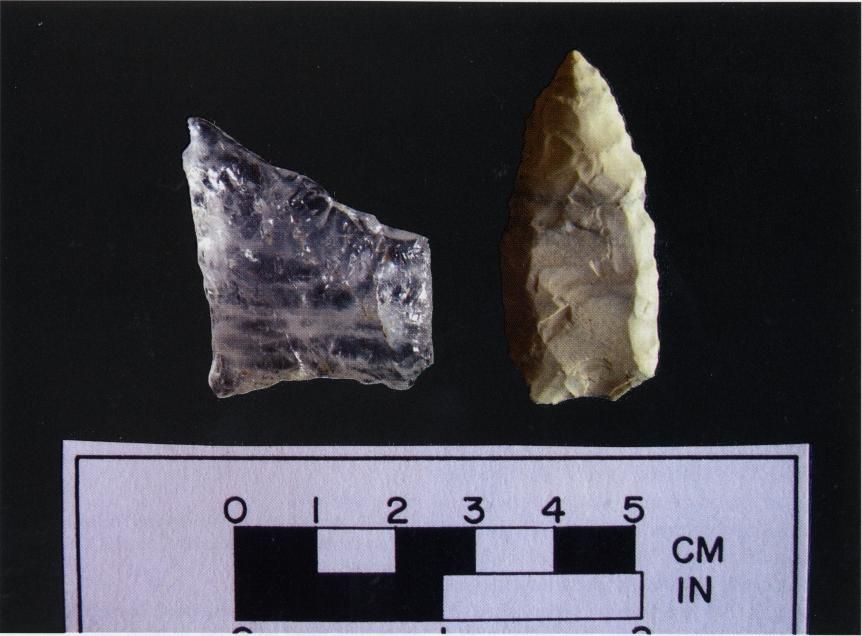
The two fluted points that we found were collected on different sites, about 40 km apart, and are different in both form and lithic mate­rial. The point in Figure 1-A, only the lower half of which remains, is what might be con­sidered typical Clovis in form. Composed of clear (or crystal) quartz, the base is 28 mm in width and 8 mm in thickness. It has promi­nent fluting on one side, extending 19 mm up from the concave base, and a lesser flute on the reverse, extending 8 mm up from the base. About 20 mm of the edges of the basal haft­ing area have been dulled by grinding, typical of Clovis and other fluted points (Peck 1998). We found very few clear quartz projectile points of any type: less than 1% of the total. But the published literature clearly suggests that clear quartz was a lithic material admired by Paleo-Indians Peck (1998, 2003, 2004), for example, shows a number of clear-quartz Clovis or Clovis-like points, several of which are similar to the one in our Figure 1-A.

The other fluted point (Figure 1-B) is com­plete except for the basal auricles (or ears), both of which were partially broken in mod­ern times. The breakage areas clearly show that the interior of the point is of a dark mate­rial, probably a form of rhyolite (see Ward and Davis 1999) whereas the patinated surface is cream to light tan in color. The patina of this point (measured at the break points as pen­etrating 0.2 – 0 3 mm into the surface of the point) is different in color and texture from all other points found at the same site and, in fact, different from virtually all other points in our collections from the east-Piedmont re­gion. Relative to other points found on our sites, the flaking is more precise and delicate. The point is 49 mm in length, 20 mm in width, and 7 mm (max.) in thickness. On one side the fluting is prominent and extends 24 mm up from the base, about half the length of the blade. On the other side, there is flaking for about 10 mm up from the base. The blade edges near the hafting area of the base show only slight smoothing or grinding.

The clear quartz point (Figure 1-A) was found in a plowed field near a small stream in Durham County, about 10 km from the city of Durham. A full spectrum of Archaic pe­riod point types were represented at the site, including (using the nomenclature of Coe 1964): Palmer, Kirk, Stanly, Morrow Moun­tain, Guilford, and Savannah River, as well as Rowan (Cooper 1970; Overstreet 2007) and miscellaneous others. Other sites within a 25 km distance, including some near the Eno River, produced Hardway side-notched and Hardaway-Dalton points, in addition to the other Archaic point types mentioned above.

Figure 1.
Two fluted points found on the surface of plowed fields, North Carolina (A) on the left, Durham County.
(B) on the right, Chatham County.

The point in Figure 1-B was found in a plowed field in Chatham County, on a low ridge near the New Hope River, now nearly inundated as part of Lake Jordan Recreational Area. Other point types found on and imme­diately adjacent to that site included a Hard­away side-notched, as well as virtually all the other Archaic point types described by Coe (1964) for the Piedmont. At two other sites within 5 km, two additional Hardaway side-notched points were found. Excavations by Claggett and Cable (1982) in the vicinity of the nearby Haw River clearly documented a strong early Archaic element, with Hardaway, Kirk and other early Archaic points represent­ed, but apparently produced no fluted points. The point in Figure 1-B is distinctive in ap­pearance, both in form and workmanship — as well as in patina, from all other points in our collections. It is similar to small Clovis and “Clovis-like” points from the Southeast pic­tured in various publications (e.g., Peck 1998; Peck 2004; Ward and Davis 1999; Daniel 2006). The two fluted points reported here, and the many early Archaic points with which they were associated, further reinforce the fact that the landscape of Piedmont North Carolina has been continuously inhabited for a period of time stretching back 10,000 or more years.

But the rarity of the earliest artifacts and their scattered occurrence is suggestive of sparse and mobile populations. McReynolds (2005) summarized the available data from various studies concerning the distribution of projec­tile points (by cultural period) in North Caro­lina. She refers to the studies of Daniel (1997, 2000, 2001) who showed that fluted points are known to occur in all three physiographic provinces of the state (i.e., Mountains, Pied­mont, Coastal Plain) but are most concen­trated in the eastern Piedmont, which would include the region of our sites. Peck (1998) reported that 643 fluted points were known to have been found in the state. Of those, nine were found in Durham County and eight in Chatham County, the counties in which we found the two reported here. The precise number of fluted points found state wide is not particularly relevant, and we can assume that many more have been collected over the years but never reported or documented — as, for example, the two that we report here for the first time. What is clear, however, is that fluted points from the Paleo-Indian period are exceedingly rare relative to other, later types, and that most occurrences of these points are as individual artifacts, rather than as assem­blages as found at a very limited number of Paleo sites in the eastern United States (see Meltzer 2009). For that reason, we feel it is important to report isolated finds such as those in Figure 1. Over time, such reports will add to the data bank on some of the earliest hu­mans in the Southeast and elsewhere, sharp­ening our understanding of their habitation, dispersion, and tool-making patterns.


“Used by Permission of the Author”
To learn more about or to join the Central States Archaeological Society, click here: CSASI.org

Recent Posts

By Kevin Jerome July 24, 2026
Explore the significance of Mississippian pottery trowels. Learn about their use in pottery-making & view our collection.
By tkxkuugb-ca June 29, 2026
Explore the Paleoindian Database for insights on Native American artifacts. Contact us for appraisals & collection support.
By tkxkuugb-ca May 16, 2026
Explore insights on Clovis tools & Scott Ashcraft's whistleblower case. Join the discussion on ethics in archaeology today!
By tkxkuugb-ca April 13, 2026
Learn about miniature Mississippian axe pendants' cultural significance. Contact us for appraisals & to buy authentic artifacts.
By Matt March 25, 2026
Explore the mystery of undrilled bird effigy pipes from TN. Learn about their significance & share your finds with us!
By tkxkuugb-ca March 20, 2026
Tune in to the Seven Ages Podcast to explore the Adena culture, Moundbuilders of the Ohio Valley. Join us for insights on Native American artifacts.
By Arrowheads March 20, 2026
Explore Gary Varient's passion for Native American artifacts. Join the community and share your collection today!
By Matt March 14, 2026
Learn to identify authentic arrowheads vs. reproductions. Consult experts for accurate appraisals and avoid costly mistakes.
By Matt March 3, 2026
Learn about the rare dugout canoe found in the Ohio River. Contact us for artifact appraisal & preservation guidance.
By tkxkuugb-ca February 21, 2026
Learn more about the Paleo American Odyssey in these articles.
Show More