
Glass Points of the California Indians

Share this article

by C. J. O’Neill, Monroe, North Carolina

Originally Published in the Central States Archaeological Journal, Vol.55, No.3, pg.128

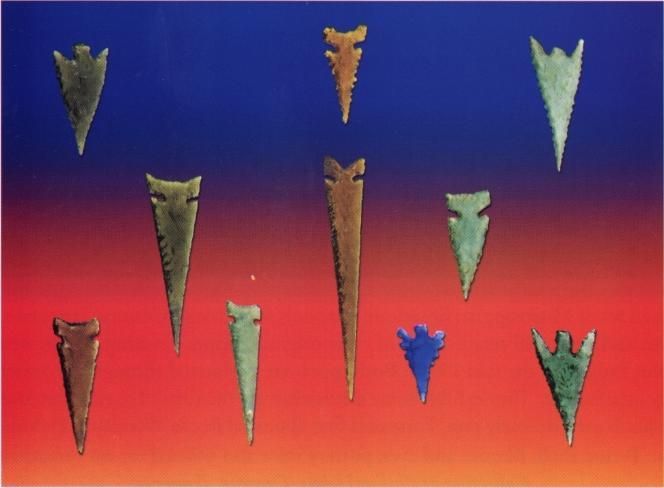
Protracted contacts with white settlers in the 19th Century in what is now California of­fer a boon today for those interested in his­toric Indian relics. While the contacts proved disastrous in virtually every way to groups of American Indians such as the Wintus and Wi­yots, for a relatively brief period it gave them a ready supply of bottle glass that augmented the native use of volcanic glass (obsidian) and other natural stones for their arrow, knife and harpoon points. Small groups of bottle glass Wintu and Wiyot points today reflect a sur­prising array of colors.

The Wintu lived primarily on the western side of the northern part of the Sacramento Valley, from the Sacramento River to the coast range. The land of the Wintu also included the southern portions of the Upper Sacramento River, the southern portion of the McCloud River, and the upper Trinity River. They also lived in the vicinity of Chico, on the west side of the river to the coast range.

The Wintu lived by fishing, hunting and gathering. Judging by the collections of points attributed to Wintu village sites, these people favored the use of varieties of desert side-notch and Gunther barbed points.

Estimates for the pre-contact populations of most native groups in California have var­ied substantially. Alfred  L.  Kroeber estimated the combined 1770 population of the Wintu, Nomlaki, and Patwin as 12,000. Sherburne F. Cook put the population of the Wintu at 5,300. Frank R. LaPena increased this to 14,250.

By 1821, many Wintus were indentured to wealthy Mexican land holders. The Wintu were first encountered by Euro-Americans in the 1826 expedition of fur trader and explorer Jedediah Smith, followed by an 1827 expedi­tion led by Peter Skene Ogden. Between 1830 and 1833, many Wintus died because of ma­laria in an epidemic that killed off 75 percent of the indigenous population of the upper and central Sacramento Valley.

In following years the remaining Wintu fell victim to the onrush of settlers, who de­stroyed the Wintu food supply by polluting the rivers with gold mining and with sheep and cattle ranching. The Wintu were forced as laborers in gold mining operations. By 1856 the east fork of Clear Creek had at least 1,000 miners.

In 1846, John Fremont, who would be­come the military governor of California in 1847, and Kit Carson killed 175 Wintu and Yana. Further efforts tried to control Wintu land and relocate them to west of Clear Creek. In a “friendship feast” of poisoned food served by whites in 1850, 100 Nomsuus and 45 Win­tus were massacred. This was followed by an­other massacre and destruction of Wintu land in 1851.

Regular and civilian troops engaged the Bald Hills and Trinity Wintu in the “Wintoon War,” lasting six months in 1858-59. Some 100 Indians were killed and 300 sent to the Mendocino Reservation. By the 1930 census, only 380 Wintus could be accounted for.

A similar fate awaited the Wyots on Gunther Island, California. Gunther Island, also known as Indian Island or Duluwat Island, is located within Eureka on Humboldt Bay. Duluwat Island (the original Wiyot name) was the site of the spiritual center of the Wiyot peo­ple. On Feb. 26, 1860, a hundred Wiyot men, women and children were massacred during a renewal ceremony. The massacre was carried out by Europeans who had settled in the area since 1850 as part of the Gold Rush. The at­tackers used hatchets, clubs and knives to kill. They purposefully avoided using guns so that local residents in nearby Eureka (several hun­dred yards across Humboldt Bay) could not hear the slaughter. Only one person, an infant, survived the attack. The island subsequently was known as Bloody Island for a significant period.”Used by Permission of the Author”
To learn more about or to join the Central States Archaeological Society, click here: CSASI.org

Recent Posts

By Kevin Jerome July 24, 2026
Explore the significance of Mississippian pottery trowels. Learn about their use in pottery-making & view our collection.
By tkxkuugb-ca June 29, 2026
Explore the Paleoindian Database for insights on Native American artifacts. Contact us for appraisals & collection support.
By tkxkuugb-ca May 16, 2026
Explore insights on Clovis tools & Scott Ashcraft's whistleblower case. Join the discussion on ethics in archaeology today!
By tkxkuugb-ca April 13, 2026
Learn about miniature Mississippian axe pendants' cultural significance. Contact us for appraisals & to buy authentic artifacts.
By Matt March 25, 2026
Explore the mystery of undrilled bird effigy pipes from TN. Learn about their significance & share your finds with us!
By tkxkuugb-ca March 20, 2026
Tune in to the Seven Ages Podcast to explore the Adena culture, Moundbuilders of the Ohio Valley. Join us for insights on Native American artifacts.
By Arrowheads March 20, 2026
Explore Gary Varient's passion for Native American artifacts. Join the community and share your collection today!
By Matt March 14, 2026
Learn to identify authentic arrowheads vs. reproductions. Consult experts for accurate appraisals and avoid costly mistakes.
By Matt March 3, 2026
Learn about the rare dugout canoe found in the Ohio River. Contact us for artifact appraisal & preservation guidance.
By tkxkuugb-ca February 21, 2026
Learn more about the Paleo American Odyssey in these articles.
Show More