
The Carter Bannerstone

Share this article

Central States Archaeological Journal, Vol. 58 No. 3

by Rodney M. Peck, Kannapolis, North Carolina

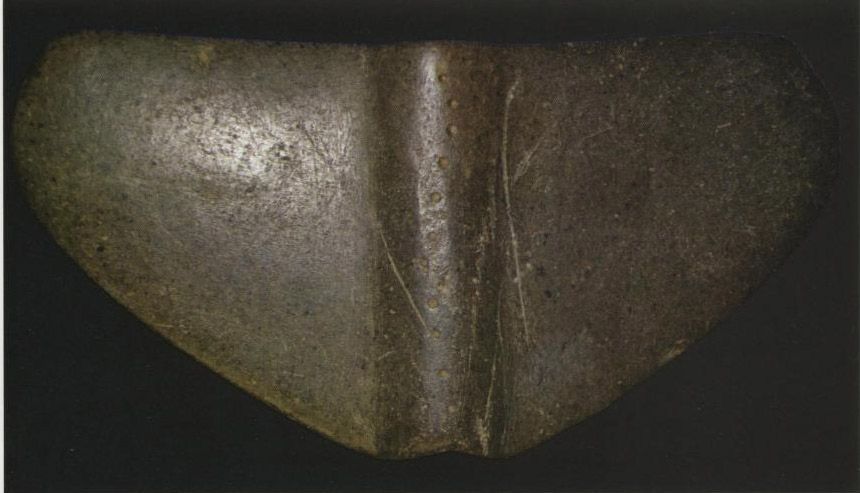
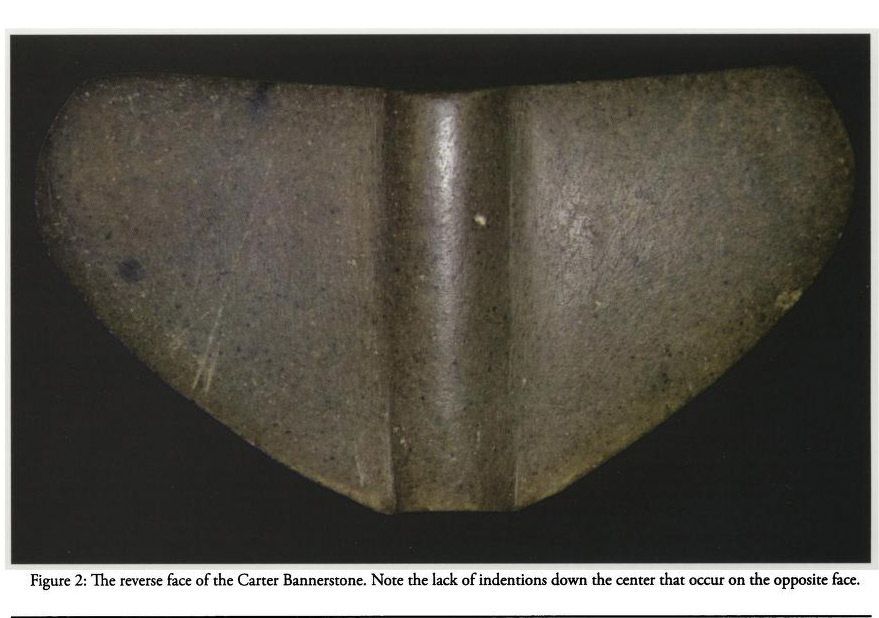
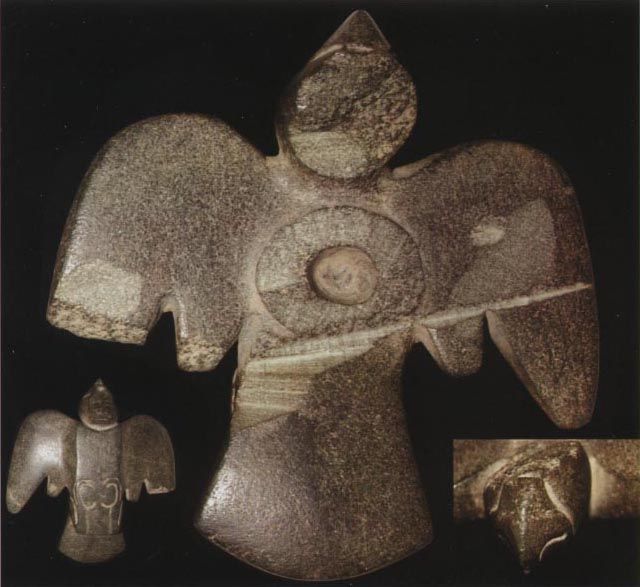
One of the most beautiful bannerstones from the southeast is known as the Carter bannerstone(Figure 1,2), named after one of its previous collectors, Loy C. Carter. It exhibits superb workmanship and the high grade of slate it is made from represents a careful selection of rock material.

The bannerstone consists of a pair of large wings that are very similar in size and shape. There is a large rounded barrel perforation. This form is referred to as the Unnotched Crescent style by Bryon Knoblock in his book Bannerstones of the North American Indian. Uniquely, there are twelve drilled indentions running down its center on one side whose purpose is unknown.

When one examines the workmanship of the ancient artisan, it is obvious how much skill was involved. First there was the quarrying in order to find a block of slate suitable to make such a large bannerstone. Second, there was the time-consuming work of pecking, grinding and scraping the stone into shape. Then once the body and the winged ends were formed, there was the slow process of drilling of the hole using a solid stick and sand. Finally, there was the polishing of the artifact itself. This bannerstone dates to the Middle Archaic time period, approximately 6500 BP, and was associated with the Morrow Mountain culture.

It was found on the surface of a plowed field in

Nansemond County, Virginia (now the city of Suffolk) on the western side of the Great Dismal Swamp.

At one time it was in the collection of Dr. Jay Goldberg of Colonial Heights, Virginia. He obtained it about twenty years ago from the late Loy C. Carter of Clarksville, Virginia. Mr. Carter probably purchased the bannerstone from the late James E. Byrd, of Suffolk, Virginia. Mr. Byrd sold the Indian artifacts he collected to the Heye Foundation Museum of the American Indian in New York as well as to private collectors in Virginia during the 1950’s-1960’s. Some of the finest artifacts that Mr. Byrd once owned may be found in many Virginia collections today. This beautiful specimen is truly one of the crémede-la-créme of southeastern Virginia bannerstones.

One face of the Carter Bannerstone. It is 5 7/8 inches long, 2 3/4 inches wide and 25/32 inches in thickness at the center. The hole diameter is approximately 1/2 inch in diameter. The material is a greenish-gray slate with small black spots scattered on the surface, which probably originated in the North Carolina Piedmont region. Note the interesting line of twelve pecked indentions down the barrel, a very rare feature. They do not appear on the reverse face.

References:

Knoblock, Byron W. 1939 Bannerstones of the North American Indian. LaGrange, III. Lutz, David L. 2000 The Archaic Bannerstone: Its Chronological History and Purpose, From 6000B.C. to 1000 B.C: Newburgh, IN.

McCary, Ben C. 1968 Bannerstones of the Dismal Swamp Area in Virginia and North Carolina. Quarterly Bulletin, Vol.22, No.4. 1975 Bannerstones from the Dismal Swamp Area and Nearby Counties in Virginia and North Carolina. Quarterly Bulletin, Vol.30, No.1.

Peck, Rodney M. 1973 The Boykins Bannerstone. The Chesopiean. Vol.11, No.5. 1984 Bannerstone Hill. Gates County, North Carolina. The Piedmont Journal of Archaeology, Vol.1. 2002 Southeastern Axes and Bannerstones. Kannapolis, NC.

The post The Carter Bannerstone appeared first on Arrowheads.com.

Recent Posts

By Kevin Jerome July 24, 2026
Explore the significance of Mississippian pottery trowels. Learn about their use in pottery-making & view our collection.
By tkxkuugb-ca June 29, 2026
Explore the Paleoindian Database for insights on Native American artifacts. Contact us for appraisals & collection support.
By tkxkuugb-ca May 16, 2026
Explore insights on Clovis tools & Scott Ashcraft's whistleblower case. Join the discussion on ethics in archaeology today!
By tkxkuugb-ca April 13, 2026
Learn about miniature Mississippian axe pendants' cultural significance. Contact us for appraisals & to buy authentic artifacts.
By Matt March 25, 2026
Explore the mystery of undrilled bird effigy pipes from TN. Learn about their significance & share your finds with us!
By tkxkuugb-ca March 20, 2026
Tune in to the Seven Ages Podcast to explore the Adena culture, Moundbuilders of the Ohio Valley. Join us for insights on Native American artifacts.
By Arrowheads March 20, 2026
Explore Gary Varient's passion for Native American artifacts. Join the community and share your collection today!
By Matt March 14, 2026
Learn to identify authentic arrowheads vs. reproductions. Consult experts for accurate appraisals and avoid costly mistakes.
By Matt March 3, 2026
Learn about the rare dugout canoe found in the Ohio River. Contact us for artifact appraisal & preservation guidance.
By tkxkuugb-ca February 21, 2026
Learn more about the Paleo American Odyssey in these articles.
Show More