
Pestles & Hammerstones

Share this article

John Duncan, French Lick, Indiana

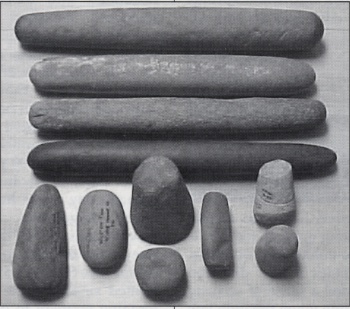
These were everyday tools of the natives. The pestles were used for grinding and mashing things such as grain for flour. The hammerstone was used for an array of things from breaking nuts to pecking out axes.

The roller pestle is a pretty rare item. It can be used in several ways. I have the good fortune of owning four of these rollers from the Randall Jones collection. They were all used differ­ently from the wear patterns.

The top one (#1) was used with the polls or ends as a mashing or grinding tool. It is from Ontario County, New York and is 20­1 / 4 inches long and made of granite. It must have had a mortar or bowl to grind in. The next one (#2) was used by rubbing it over the grain, giving it a flat side that is well worn. It is from Blytheville, Arkansas and is 18-1 / 4 inches long. It is also made of granite. The third one has an angled poll, indicating it was used at an angle to crush or grind. It is also from Blytheville and is 18­1 / 4 inches long and made of diorite. The last has little or no wear and might have been a ceremonial item as it is very well polished and smooth. It is 18-1 / 2 inches and made from green hardstone.

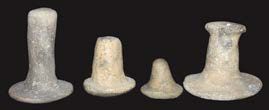
The next group are personal finds from Indiana. Number (5) was found on the Ballard (now Wilstem) farms in Orange County and is a very well worn pestle made of very pretty hardstone. The shape is uncommon and wear indicates it was used as a grinder or masher. Number (6) is a hammerstone from Orange County. Both ends have wear, indicating it was used to hammer to create a preform for a bannerstone, axe, or other item. Number (7) is a very large “hoof” pestle from Martin County. It is made of flint, which is quite uncommon. It would naturally be very hard, so it could have been used to crush grain to a fine powder. Number (8) is a unique hammer from Martin County. It has dimples on all six sides, making it fit the hand very well. The dimples make it easy to keep a grip. It might have been used to pound sinew or fat. Number (9) is much the same, but long. It, too, has nice dimples and is easy to keep a grip on. Number (10) is one of my favorites. I found the first half in 1995 (in Orange County) and thought I had part of a large roller. I found the other half in 1997 and discovered it was just a nice quartz pestle. The last one (#11) is a smaller bell or “hoof” pestle also from Orange County. Worn on the bottom, it was used to grind or mash, probably with a bowl or mortar.

The post Pestles & Hammerstones appeared first on Arrowheads.com.

Recent Posts

By Kevin Jerome July 24, 2026
Explore the significance of Mississippian pottery trowels. Learn about their use in pottery-making & view our collection.
By tkxkuugb-ca June 29, 2026
Explore the Paleoindian Database for insights on Native American artifacts. Contact us for appraisals & collection support.
By tkxkuugb-ca May 16, 2026
Explore insights on Clovis tools & Scott Ashcraft's whistleblower case. Join the discussion on ethics in archaeology today!
By tkxkuugb-ca April 13, 2026
Learn about miniature Mississippian axe pendants' cultural significance. Contact us for appraisals & to buy authentic artifacts.
By Matt March 25, 2026
Explore the mystery of undrilled bird effigy pipes from TN. Learn about their significance & share your finds with us!
By tkxkuugb-ca March 20, 2026
Tune in to the Seven Ages Podcast to explore the Adena culture, Moundbuilders of the Ohio Valley. Join us for insights on Native American artifacts.
By Arrowheads March 20, 2026
Explore Gary Varient's passion for Native American artifacts. Join the community and share your collection today!
By Matt March 14, 2026
Learn to identify authentic arrowheads vs. reproductions. Consult experts for accurate appraisals and avoid costly mistakes.
By Matt March 3, 2026
Learn about the rare dugout canoe found in the Ohio River. Contact us for artifact appraisal & preservation guidance.
By tkxkuugb-ca February 21, 2026
Learn more about the Paleo American Odyssey in these articles.
Show More