
Gamestones: A Mississippian Enigma

Share this article

by Col. John F. Berner
Central States Archaeological Journal, Vol. 55, No.2, pg.72

The Mississippian culture which began around 900 AD and terminated in the late 1400’s left an indelible mark on the prehis­tory of the United States. We know that Coles Creek, Etowah,Cahokia, Spiro and the Ohio Valley Ft. Ancients played a significant part. Phases such as Hiawassee, Mouse Creek, Dal­las were established during this period.

Just prior to the Mississippian period the use of discoidals began with the Jersey Bluff cul­ture.They manufactured large, heavy granite and quartzite circular discs. French religious explorers witnessed and documented historic tribes playing rolling games and wagering ev­erything they owned on the outcome of these discoidal games.

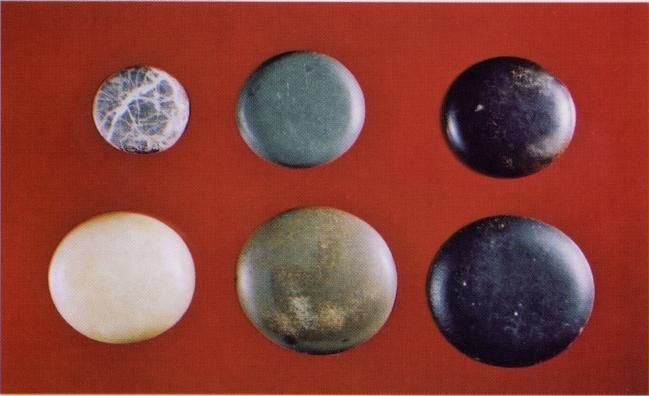
Figure 1: Marble 1″, Murray Co., GA., Greenstone 1 3/8″, Bradley Co., TN., Hematite 1  1 /4″Mississippi Co., AR., Quartzite 1 5/8″, Floyd Co., GA., Greenstone 1  3 /4″, Polk Co., TN., Diorite, 1 3/4″, Henry Co., TN.

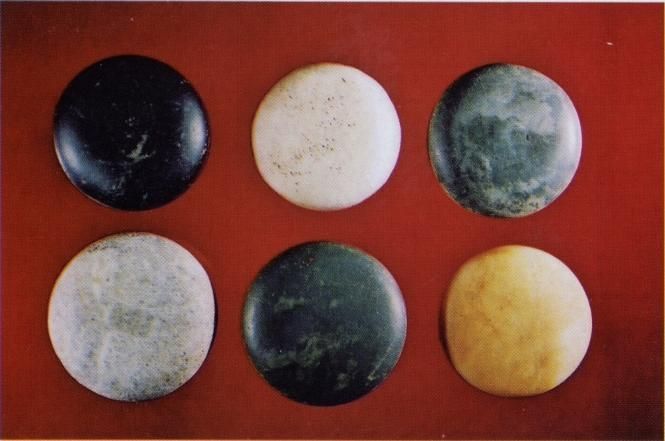
Figure 2: Diorite, 1 13/16″, Walton Co., FL., White Flint 1 13/16″, Greene Co., TN., Greenstone, 1  3 /4″, Bradley Co., TN., Limestone 2″, Floyd Co., GA., Greenstone 1  3 /4″, Polk Co., TN., Golden quartzite, 1 7/8″, TN.

Following Jersey Bluff were Cahokia types Apple types from Arkansas and Missouri, rare Salt River types from Missouri and most impressive single and double cup Tennessee types. These were made of the most impres­sive and colorful stones including a variety of quartzites and especially a golden translucent quartzite. A few were manufactured from reddish / orange ferruginous quartzite.These discoidals range from 4 to 6 inches.

Being native of Southwestern Ohio, I sel­dom noticed the Mississippian artifacts called “Gamestones”. They appeared to me to be a miniaturization of the larger and earlier gam­ing artifacts, but what kind of game would engage these smaller counterparts?

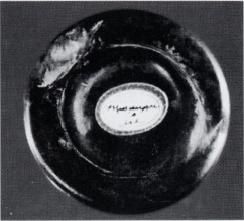
Most gamestones are round and flat, oc­casionally slightly raised on each side and referred as biscuit types. A few are described as “circle roller” types because one side is a larger diameter causing it to roll in a circle as it comes to rest. One rare type of hema­tite, from Mississippi County, Arkansas was relief carved on one side ( figure 3 ).

Gamestones are made of diorite, green-stone, hematite, quartzite, limestone and flint. The majority are less than three inches in diameter and one and one quarter inches in thickness. The smallest known made of gray and white marble measures just one inch. If they were used like other types of discoidals, what kind and size of gaming field did they employ?

Figure 3: back side of Hematite 1 VI” example from Mississippi Co., AR.

Perforated and engraved sandstone discs similar in size are found at Ft.Ancient sites in the Ohio River valley. Gamestones (like discoidals) have definite wear patterns on the rolling surface. They are not common and found throughout the southeastern states.

If these tiny artifacts were used like their larger counterparts, then they are truly a Mississippian enigma.

   “Used by Permission of the Author”

       To learn more about or to join the Central States Archaeological Society, click here:  http://www.csasi.org/  .

Recent Posts

By Kevin Jerome July 24, 2026
Explore the significance of Mississippian pottery trowels. Learn about their use in pottery-making & view our collection.
By tkxkuugb-ca June 29, 2026
Explore the Paleoindian Database for insights on Native American artifacts. Contact us for appraisals & collection support.
By tkxkuugb-ca May 16, 2026
Explore insights on Clovis tools & Scott Ashcraft's whistleblower case. Join the discussion on ethics in archaeology today!
By tkxkuugb-ca April 13, 2026
Learn about miniature Mississippian axe pendants' cultural significance. Contact us for appraisals & to buy authentic artifacts.
By Matt March 25, 2026
Explore the mystery of undrilled bird effigy pipes from TN. Learn about their significance & share your finds with us!
By tkxkuugb-ca March 20, 2026
Tune in to the Seven Ages Podcast to explore the Adena culture, Moundbuilders of the Ohio Valley. Join us for insights on Native American artifacts.
By Arrowheads March 20, 2026
Explore Gary Varient's passion for Native American artifacts. Join the community and share your collection today!
By Matt March 14, 2026
Learn to identify authentic arrowheads vs. reproductions. Consult experts for accurate appraisals and avoid costly mistakes.
By Matt March 3, 2026
Learn about the rare dugout canoe found in the Ohio River. Contact us for artifact appraisal & preservation guidance.
By tkxkuugb-ca February 21, 2026
Learn more about the Paleo American Odyssey in these articles.
Show More