
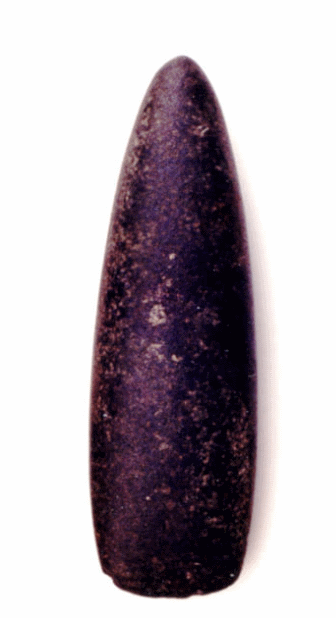
A TAPERED CELT FROM MICHIGAN

Share this article

Douglas A. Whitcomb, Wolverine, Michigan 

    It was 1952, and I was in second grade when I saw my first Indian artifact. We were studying the local Indians and a classmate brought in the artifact for the class to see. Her older brother had found it a few years earlier along the banks of Crockery Creek in our hometown of Ravenna in Muskegon County, Michigan. I do not recall that anyone, including the teacher, knew what the artifact actually was or what its use might have been, but we could all tell that it had been made by a prehistoric man.

    The following year we had the same teacher and again had a unit on Michigan’s earliest inhabitants, the Indians. By this time, my interest in Indian artifacts had grown very strong. My father encouraged this and showed me a round tobacco tin full of arrowheads that my grandfather had found on his farm in Allegan County, Michigan.  

    Again my classmate brought in the Indian stone. I, of course, wanted to start my own collection, or more likely, I just wanted to be able to hold it and look at it anytime I wanted to. I only had two dollars and wondered if that would be enough to entice her or her brother to part with the artifact. After 47 years, I still remember the conversation like it was yesterday. As we left the classroom at the end of the day, there was a moment in the hall when we were somewhat alone. I said to her, “You know that Indian stone?” She never gave me a chance to offer my two dollars; she just answered, “Yeah, do you want it?” I was stunned and stammered out, “Yes.” At that, she handed it over to me, and I walked home in a daze.

    Robert N. Converse in his book Ohio Stone Tools offers a perfect description of this artifact.  He calls it a tapered celt and describes it as “usually long and oval in center cross-section. The bits are sharpened equally from both sides. There are no angular facets on the balance of the piece, all surfaces being smoothly rounded. Classic examples are scarce.” With regards to size and materials used, he states, “Most tend to be fairly large–7 or 8 inches in length–and are made from heavy, dense stone of high quality. Collections from Seip Mound, the Harness Mound, and the original Hopewell works in the Ohio State Museum include this celt form” (Converse 1973). 

   The particular celt that I obtained as a youngster is 9 3/4 inches long and 3 inches at its widest point which is about 3 inches from the bit. It is made from a fine-grained hardstone material that is a dark bluish-gray in color. Judging from where it was found, a creek bank, and the few small prehistoric nicks on the bit, I believe that it had been used perhaps near the area it was found for some woodworking endeavor. Then it was either left there on purpose or lost by its maker.  

    Crockery Creek is a tributary of the Grand River. The location where the celt was found is almost equidistant between the Grand and Muskegon River Valleys, and both areas were occupied when the Hopewell culture was flourishing during the Middle Woodland period. some 2000 years ago (Quimby 1960 and Fitting 1970). 

REFERENCES 

Converse, Robert N. 

1973, Ohio Stone Tools, The Archaeological Society of Ohio.

Fitting, James E. 

1970, The Archaeology of Michigan. The Natural History Press, Garden City, New York.

Quimby, George I. 

1960, Indian Life in the Upper Great Lakes.

The University of Michigan Press, Chicago, Illinois.

Article used by permission from Douglas A. Whitcomb, Author

The post A TAPERED CELT FROM MICHIGAN appeared first on Arrowheads.com.

Recent Posts

By Kevin Jerome July 24, 2026
Explore the significance of Mississippian pottery trowels. Learn about their use in pottery-making & view our collection.
By tkxkuugb-ca June 29, 2026
Explore the Paleoindian Database for insights on Native American artifacts. Contact us for appraisals & collection support.
By tkxkuugb-ca May 16, 2026
Explore insights on Clovis tools & Scott Ashcraft's whistleblower case. Join the discussion on ethics in archaeology today!
By tkxkuugb-ca April 13, 2026
Learn about miniature Mississippian axe pendants' cultural significance. Contact us for appraisals & to buy authentic artifacts.
By Matt March 25, 2026
Explore the mystery of undrilled bird effigy pipes from TN. Learn about their significance & share your finds with us!
By tkxkuugb-ca March 20, 2026
Tune in to the Seven Ages Podcast to explore the Adena culture, Moundbuilders of the Ohio Valley. Join us for insights on Native American artifacts.
By Arrowheads March 20, 2026
Explore Gary Varient's passion for Native American artifacts. Join the community and share your collection today!
By Matt March 14, 2026
Learn to identify authentic arrowheads vs. reproductions. Consult experts for accurate appraisals and avoid costly mistakes.
By Matt March 3, 2026
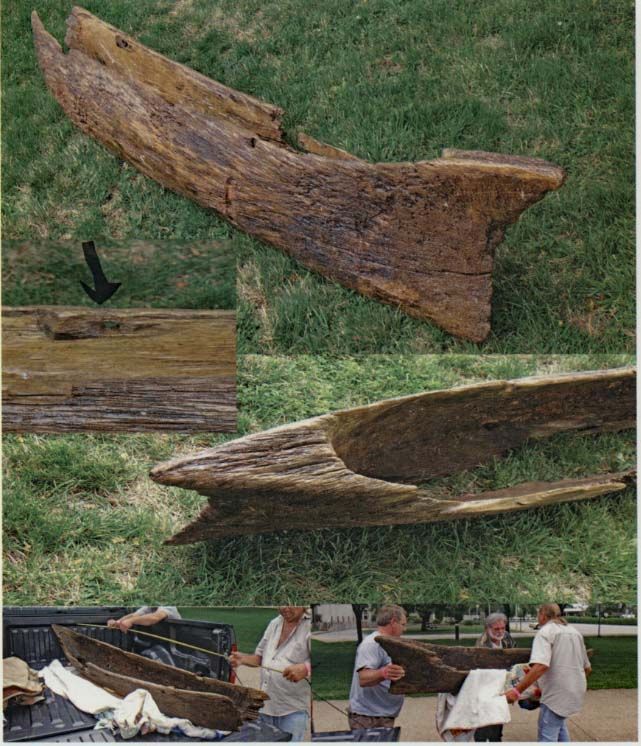
Learn about the rare dugout canoe found in the Ohio River. Contact us for artifact appraisal & preservation guidance.
By tkxkuugb-ca February 21, 2026
Learn more about the Paleo American Odyssey in these articles.
Show More