
WHEN CUMBERLANDS WERE CALLED FOLSOMS

Share this article

By Richard Michael Gramly, Ph.D.
American Society for Amateur Archaeology

Although most collectors envision a Cumberland point to be a thick biface, fluted on both sides (sometimes to the tip), with a fish-tailed or waisted haft, the fact is there is considerable variation in thickness, fluting, and the degree to which the base flares or is fish-tailed. Even the very name for the point type has changed over the centuries. Centuries, you say!? Yes, Cumberland points have been known to collectors for centuries.

The earliest detailed illustration of a North American flaked stone point that today would be termed a Cumberland (Barnes) point is shown as Figure 7 in Plate IV of Luigi Castiglione’s  Viaggio.  This book is a product of the naturalist’s travels throughout the United States during 1785-1787. Although the collection locality of the point is not given, likely it was presented to Castiglione by fellow naturalist, Rev. Manesseh Cutler, a resident of Ipswich, Massachusetts (Gramly 2007; Pace 1983:26). The present whereabouts of this specimen are unknown, but it may be languishing in some desk drawer of the Castiglione villa in Milan, Italy.

During the nineteenth century Cumberland points, which were so skillfully made and interestingly shaped, found their way into public and private collections. Although their character was sometimes noted, at the time they were not given special designations. In  The Antiquities  of Tennessee,  Gates Thruston illustrated a Cumberland fluted point from Maury County, Tennessee, and simply termed it a “specialty” of that county (1890:232, Figure 139). Also, some time before 1898 a Cumberland point —likely a later variety known as Barnes—was collected at Big Bone Lick, Boone County, Kentucky. Big Bone Lick is an important fossil locality, which has been visited by natural historians since the eighteenth century. Not until 60 years after Herbert Schiefer had secured the point from its original finder, however, was it finally illustrated (Prufer 1960).

Among the earliest illustrations of Cumberland points in archaeological publications we note Plate V in Figgins’ 1935 report about “Folsom and Yuma artifacts” for the Colorado Museum of Natural History. Two indubitable Cumberland points attributed to Ohio are shown, which Figgins classed as Folsom. A colleague of his, Edgar B. Howard, as Figgins himself observed, preferred the designation, “Folsom-like”. Four years later these same Cumberland points illustrated by Figgins were termed “generalized Folsom points” by Marie Wormington (1939:10). By 1957 in a later edition of her classic,  Ancient Man in North America,  Marie Wormington had dropped this wording in favor of calling them “Ohio or Cumberland Fluted Points” (see Figure 29, page 82). Undoubtedly she had become familiar with Thomas M.N. Lewis’ newly-coined name, “Cumberland point,” which appeared in a 1954 issue of the  Bulletin of the Oklahoma Anthropological Society.  Although usage of the term, “Ohio fluted,” persisted as late as 1960 among publications, within a few years it had disappeared from archaeologists’ vocabulary.

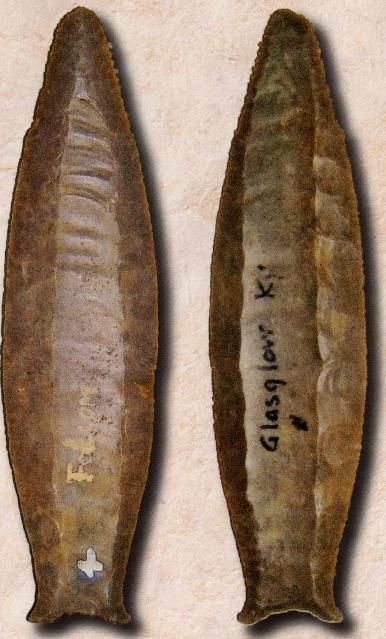
Two views of the Grievo Cumberland point, length 478″. The anciently impacted tip has been resharpened by fine pressure work, resulting in serration. The claim that this point lay locked and forgotten within a safe since (at least) 1945 is supported by the inked designation, “Folsom” upon it. Kirk Spurr photograph used by permission. R.M. Gramly.

Analysts had come to understand that the distribution of Cumberland points was much wider than just the Ohio River region or even the Cumberland River and its tributaries.  Since so many examples of Cumberland points had been collected within the greater Cumberland Valley however, this name stuck (Perino 1985:94)

The Changing Designations of the Cumberland Type

Although by the 1960s the name for Cumberland points had become fixed, during the same decade archaeologists began to recognize different varieties of Cumberland points.  In the Great Lakes (Michigan, Ontario) Paleo-American sites with the “Barnes variant” were reported (Wright and Roosa 1966).  The trend towards sub-dividiing the class of Cumberland points and defining sub-categories continues.  The need for a chronological framework, that is to say, absolute dating evidence, has become acute.

To collectiors of Paleo-American projectile points, evolving designations may seem confuising and unimportant.  In fact, knowing what a specimen was once called is useful information about the period when it was collected. A Cumberland point that entered a museum or private collection during the 1930s is almost assuredly an authentic, ancient artifact and not a fraudulent manufacture of some anonymous “flint-jack.” So, it is wise to pay close attention to catalogued descriptions and designations of Cumberland points.

An instance when an inked label on a specimen supported a claim about its authenticity is the magnificent Cumberland point shown in the accompanying photographs. As the story goes, this point and hundreds of other relics had been locked away since 1945 in a large safe. The safe was in a New Jersey home, and its contents were unknown until enterprising antique dealers paid a professional safe­cracker nearly $1000 to open it. The contents revealed, a deal was struck between the owners and the dealers, and the collection began to be marketed.

Upon a face of this 4’/s” long point, made of patinated Kentucky gray chert (Ste. Genevieve?), is written in black ink “Glasglow [sic], KY”; while the other face bears the designator, “Folsom,” in dirty, white ink. Since Cumberland points were termed Folsom points only during the 1930s, it stands to reason that this point from central Kentucky entered a collection at that time—strengthening the claim that it had been found within a safe unopened for over 60 years!

An interesting side-bar about this particular Cumberland, which I term the “Grievo point” after one of the dealers who had the safe cracked, is its tip. It suffered an impact fracture anciently and was nearly retipped by fine pressure flaking resulting in serrations. Serrating on Cumberland points appears to be a product of resharpening. Pristine points may not show serrating. Collectors take note.

Recent Posts

By Kevin Jerome July 24, 2026
Explore the significance of Mississippian pottery trowels. Learn about their use in pottery-making & view our collection.
By tkxkuugb-ca June 29, 2026
Explore the Paleoindian Database for insights on Native American artifacts. Contact us for appraisals & collection support.
By tkxkuugb-ca May 16, 2026
Explore insights on Clovis tools & Scott Ashcraft's whistleblower case. Join the discussion on ethics in archaeology today!
By tkxkuugb-ca April 13, 2026
Learn about miniature Mississippian axe pendants' cultural significance. Contact us for appraisals & to buy authentic artifacts.
By Matt March 25, 2026
Explore the mystery of undrilled bird effigy pipes from TN. Learn about their significance & share your finds with us!
By tkxkuugb-ca March 20, 2026
Tune in to the Seven Ages Podcast to explore the Adena culture, Moundbuilders of the Ohio Valley. Join us for insights on Native American artifacts.
By Arrowheads March 20, 2026
Explore Gary Varient's passion for Native American artifacts. Join the community and share your collection today!
By Matt March 14, 2026
Learn to identify authentic arrowheads vs. reproductions. Consult experts for accurate appraisals and avoid costly mistakes.
By Matt March 3, 2026
Learn about the rare dugout canoe found in the Ohio River. Contact us for artifact appraisal & preservation guidance.
By tkxkuugb-ca February 21, 2026
Learn more about the Paleo American Odyssey in these articles.
Show More