
THE PALEO END SCRAPER

Share this article

By Tony Baker as Edited by Gene Hynek

The Paleo End Scraper (PES) is an extremely important artifact because it is a temporal indicator, like the projectile. Dr. Frison has written that  spurred end scrapers (PES) are  another possible Paleoindian diagnostic . . .  (1991:128). From my experience, they are second only to the projectile point as indicators of the Paleoindian tradition.

Figure 1.

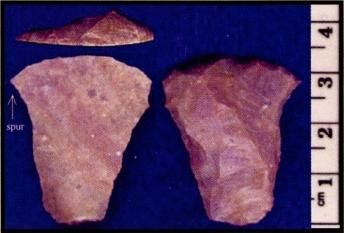
The PES is a triangular end scraper, about the size of a silver dollar, with a spur at the intersection of the lateral edge and the distal end. The spur is the most diagnostic attribute of the PES. Figure 1 shows spurs on both sides which is the case on approximately 50% of the PESs. Actually, many spurs are broken off the artifacts, presumedly through use.

A PES is made on a flake from a variety of sources, e.g. quarry sample, thin biface, etc. The bulb of percussion is located on the proximal end on approximately 90% of the artifacts. The lateral edges are usually retouched, as shown in Figure 1, on the left lateral edge. Retouch can also take the form of notches like the one located just back of the distal end on the right lateral edge. Lithic materials employed tended to be tough, but they were usually not quartzites. Jaspers and chalcedonies were the materials of choice.

Figure 2 is a classic PES with a prominent spur on the right side. There appears to have been another spur on the left side. The tiny spur on the left side, about .5 cm back from the distal edge, is the remains of that spur. Both lateral edges have been retouched and the right one appears to have done service as a spokeshave on a shaft of 1+ centimeters. This spokeshave is located just back of the spur. The distal edge is perpendicular to the long axis of the scraper.

Figure 2.

The PES begins its life as a flake knife. If it was hafted, the lateral edges were probably retouched to make it fit the haft, but not necessarily. As the PES was used, it became dull and was resharpened (Deller and Ellis 1992:56; Goodyear 1974:44; Witthoft 1952:16). Sometimes it was reshaped to perform a different function or sometimes it was damaged beyond repair and discarded before its time.

The process of use, resharpening, reshaping and reuse slowly modified the flake into an artifact that archaeologists can recognize and identify as a PES. However, the stage at which this recognition becomes possible is unknown. Function and resharpening creates a recognizable form in the PES and destroys the same in the projectile.

I am defining wear patterns as the visual appearance and feel of the usage edge when the PES is found in the archaeological record. There are at least three items that contribute to wear patterns. These are function, stage of exhaustion, and events that occur after the tool is lost or discarded by its user.

Function probably has the most impact on the wear pattern. Working hard materials such as bone or wood will leave wear patterns that are extremely different from the ones that are created by working soft materials such as hides. It is only after extensive use that the wear patterns of different functions become apparent. Both function and stage of exhaustion contribute to the wear patterns the archaeologist observes.

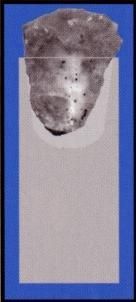
Most of the literature leaves one with the opinion that some of the PESs were hafted and that some were not (Fig. 3). Judge says just that in his  Paleoindian Occupations of the  Central Rio Grande Valley in New Mexico  (1973:187).

Within any site there will be a mixture of PES with these hafted and unhafted characteristics. More importantly, there may be a mixture of the hafted and unhafted characteristics on the individual PESs.

I strongly agree with statistics that indicate PESs exhibit minimal variation in shape.  In  fact, the only other tool that has less variation in shape is the projectile point of a particular group of people. As they were resharpened the variation between points increased. The PESs, on the other hand, were manufactured with such great variation that they could not even be classified as such in the beginning. As they were resharpened in the haft, the variation between them decreased until they became recognizable as PESs.

As I stated earlier, the spur is the most diagnostic attribute (characteristic) of a PES. I believe and propose it results from lateral edge work to socket the PES, followed by resharpening that reduces the PES to an exhausted tool. The spur did not exist at the time of hafting—it is a natural result of the process of use and resharpening of the PES.

The post THE PALEO END SCRAPER appeared first on Arrowheads.com.

Recent Posts

By Kevin Jerome July 24, 2026
Explore the significance of Mississippian pottery trowels. Learn about their use in pottery-making & view our collection.
By tkxkuugb-ca June 29, 2026
Explore the Paleoindian Database for insights on Native American artifacts. Contact us for appraisals & collection support.
By tkxkuugb-ca May 16, 2026
Explore insights on Clovis tools & Scott Ashcraft's whistleblower case. Join the discussion on ethics in archaeology today!
By tkxkuugb-ca April 13, 2026
Learn about miniature Mississippian axe pendants' cultural significance. Contact us for appraisals & to buy authentic artifacts.
By Matt March 25, 2026
Explore the mystery of undrilled bird effigy pipes from TN. Learn about their significance & share your finds with us!
By tkxkuugb-ca March 20, 2026
Tune in to the Seven Ages Podcast to explore the Adena culture, Moundbuilders of the Ohio Valley. Join us for insights on Native American artifacts.
By Arrowheads March 20, 2026
Explore Gary Varient's passion for Native American artifacts. Join the community and share your collection today!
By Matt March 14, 2026
Learn to identify authentic arrowheads vs. reproductions. Consult experts for accurate appraisals and avoid costly mistakes.
By Matt March 3, 2026
Learn about the rare dugout canoe found in the Ohio River. Contact us for artifact appraisal & preservation guidance.
By tkxkuugb-ca February 21, 2026
Learn more about the Paleo American Odyssey in these articles.
Show More