
THE MAKING OF FOLSOM POINTS

Share this article

By Bob Patten

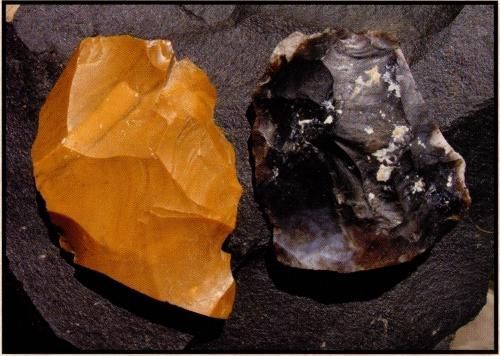
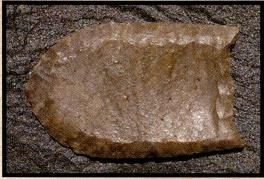
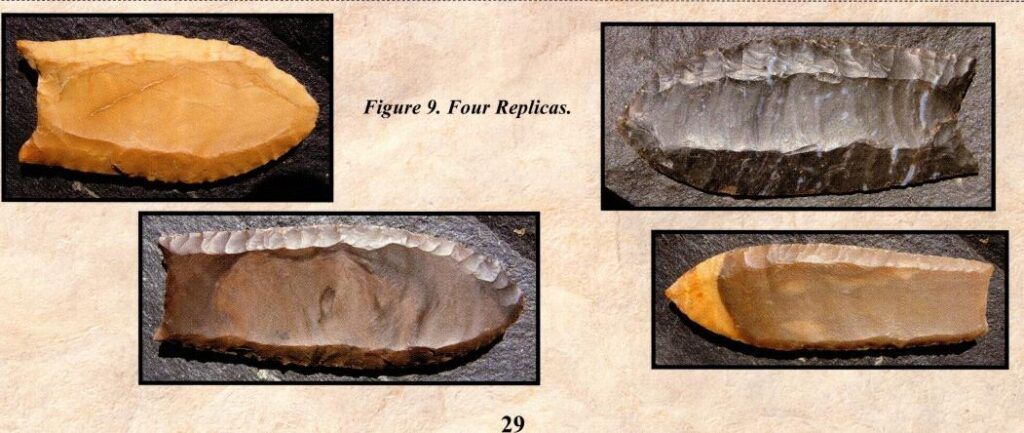
Folsom points draw inordinant attention by their unique design, but their means of construction has largely remained mysterious. The following essay shares insights gained from nearly fifty years of experimentation, guided by comparison to the archaeological record. The artifacts shown were salvaged from a site being exposed by gully erosion in the mountains of southern Colorado. Replicas (labeled) were made by the author.

Figure 1.

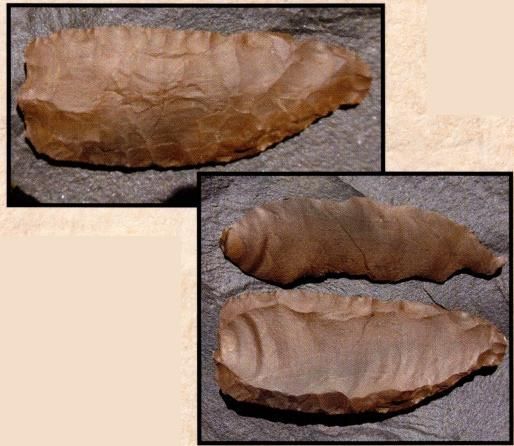
The two biface fragments in Fig. 1 are typical of Folsom technology, with flake scars that run far across the faces. Before a projectile point was pressed into service, the archaeological record suggests that roughly 150 flakes were extracted from as many as three cores, to be used as camp tools. By delaying the removal of each tool flake until it was ready to be used, Folsom craftsmen achieved the greatest mobility, allowing every scrap of stone carried from the quarry to be used effectively. Flutes were just two more specialized flakes among nearly 200 others.

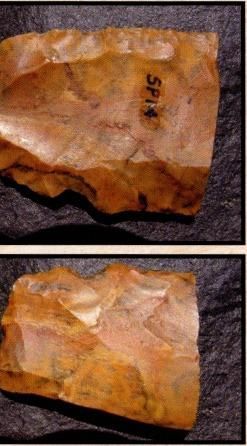
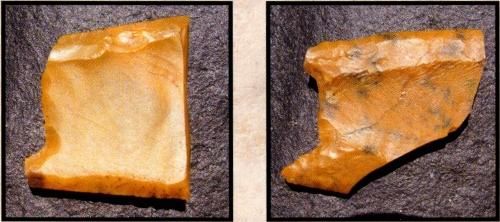
Broken bases of preforms (Fig. 2) frequently demonstrate that the first face was refined and fluted before attempting the second flute.

Figure 2.

The first flute was removed successfully from the next specimen (Fig. 3). Retouch on the second face is almost always more closely spaced because the preform is narrower. When this preform split in two during the final fluting attempt, it left a clear record of the sequence of events.

Figure 3.

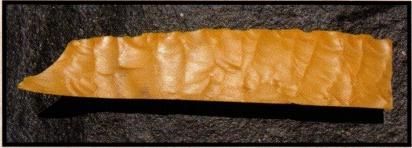
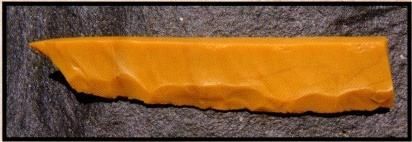
Some replicas (Fig. 4) show the relationship between the preform and detached flute.

Figure 4.           

Figure 5.

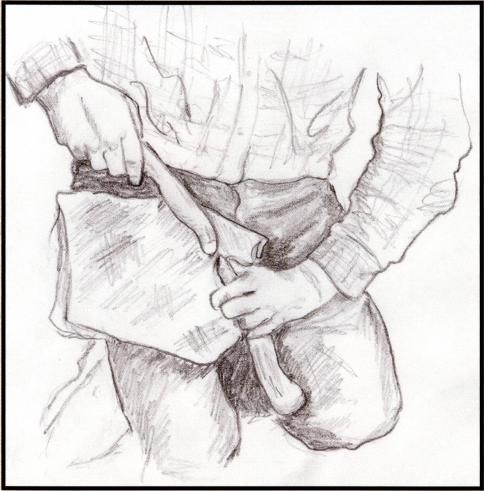
Many techniques have been advanced to explain how Folsom points were fluted. Since they all work to some degree, it is difficult to say with complete assurance which particular method is “right.” However, based on the physics of fracture, and archaeological evidence, I favor direct percussion against an anvil base (Fig. 6). This approach requires no special equipment or change in flake removal practices beyond what would have been needed to provide camp tools.

Figure 6.

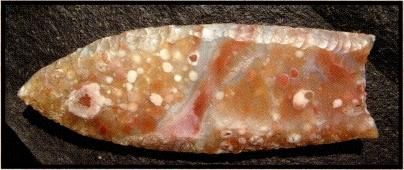
Seldom can Folsom points be found in the pristine condition represented by the next replica (Fig. 7). Evaluation of archaeological evidence leads me to believe that as few as a dozen points per person would have been needed each year. Retrieval and re-use would have been essential for minimizing trips to the quarry.

Figure 7.

Original makers of Folsom points may have been most proud of the point that survived the most uses—sometimes called a slug (Fig. 8). Experiments suggest that each point averaged about five hits, causing them to lose about sixty percent of the starting length.

Why, after achieving what many consider a pinnacle of flintknapping, was the practice of fluting abandoned? I believe that it had to do with a change of climate. During the peak of Folsom practice, a wet climate allowed bison to flourish but also made their location unpredictable. Drier times helped hunters anticipate good hunting locales near fewer remaining water sources. I believe fluting arose as a way to travel farther away from quarries. When less travel was required and stone did not have to be conserved so rigorously, fluting disappeared.

More information about fluted points can be found in Bob Patten’s book  Peoples Of The Flute: A Study in  Anthropolithic Forensics,  available through Stone Dagger Publications.

In 2004, the Society for American Archaeology honored Bob with the Crabtree Award in recognition of his fifty years of reconstructing knapping processes. He has authored two books:  Old Tools—New Eyes: A Primal  Primer of Flintknapping  and  Peoples of the Flute: A Study in Anthropolithic Forensics.  Now retired from the USGS, he demonstrates flintknapping annually at the Loveland, Colorado Stone Age Fair. You may have seen Bob make a Clovis point in the NOVA video “The Search for the First Americans”, first aired in 1990. Each of his replicas is initialed and dated with a diamond scribe.

The post THE MAKING OF FOLSOM POINTS appeared first on Arrowheads.com.

Recent Posts

By Kevin Jerome July 24, 2026
Explore the significance of Mississippian pottery trowels. Learn about their use in pottery-making & view our collection.
By tkxkuugb-ca June 29, 2026
Explore the Paleoindian Database for insights on Native American artifacts. Contact us for appraisals & collection support.
By tkxkuugb-ca May 16, 2026
Explore insights on Clovis tools & Scott Ashcraft's whistleblower case. Join the discussion on ethics in archaeology today!
By tkxkuugb-ca April 13, 2026
Learn about miniature Mississippian axe pendants' cultural significance. Contact us for appraisals & to buy authentic artifacts.
By Matt March 25, 2026
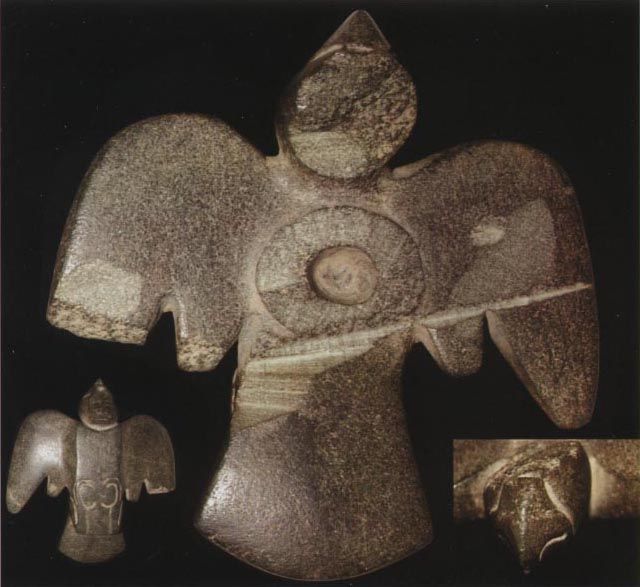
Explore the mystery of undrilled bird effigy pipes from TN. Learn about their significance & share your finds with us!
By tkxkuugb-ca March 20, 2026
Tune in to the Seven Ages Podcast to explore the Adena culture, Moundbuilders of the Ohio Valley. Join us for insights on Native American artifacts.
By Arrowheads March 20, 2026
Explore Gary Varient's passion for Native American artifacts. Join the community and share your collection today!
By Matt March 14, 2026
Learn to identify authentic arrowheads vs. reproductions. Consult experts for accurate appraisals and avoid costly mistakes.
By Matt March 3, 2026
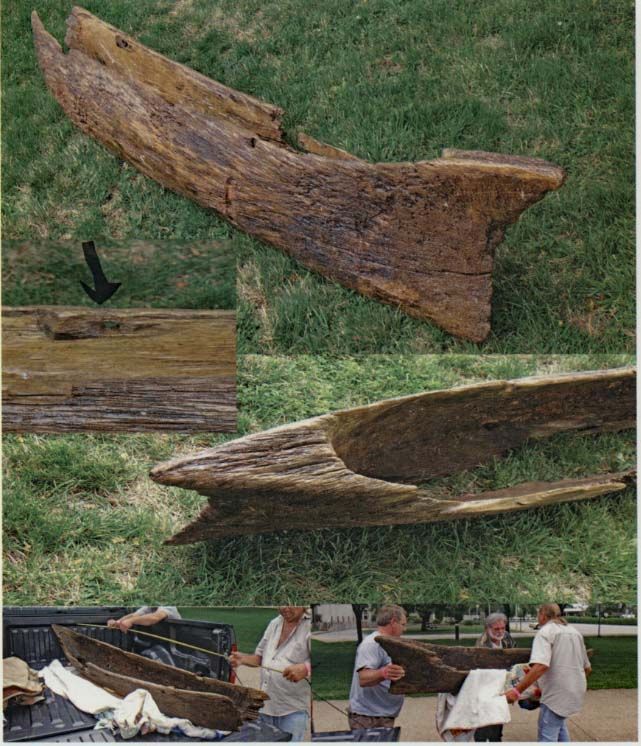
Learn about the rare dugout canoe found in the Ohio River. Contact us for artifact appraisal & preservation guidance.
By tkxkuugb-ca February 21, 2026
Learn more about the Paleo American Odyssey in these articles.
Show More