
The Harpeth River Point

Share this article

by Steven R. Cooper, Editor-in-Chief

Originally Published in the Central States Archaeological Journal, Vol.55, No.3, pg.158

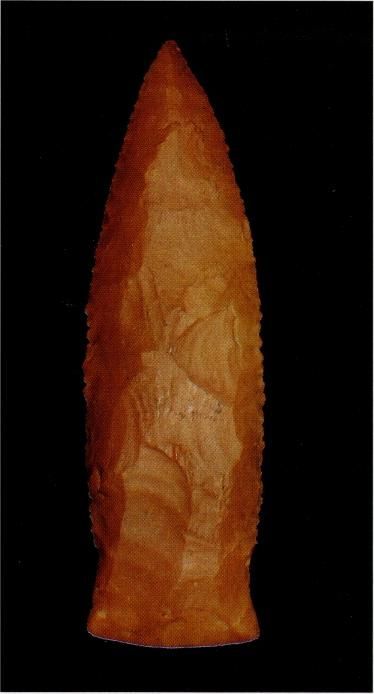
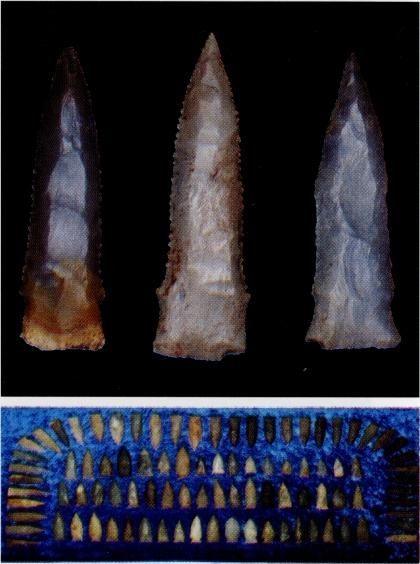
I feel lucky to live by a river that has actu­ally had a point style named after it. This point type was named by James W. Cambron after a local collector, Wayne Crabtree, found numer­ous examples along this river in Cheatham and Dickson Counties Tennessee. However, the point is not limited to this small area, and I have seen many found in Kentucky along the Cum­berland River drainage (Figures 1 and 2). They are also found in Northern Alabama and Mis­sissippi. These are considered to be Transitional Paleo and/or Early Archaic points. One of these points was found associated with a cache of four stemmed Kirk Points in January 1993, helping to accurately date them.

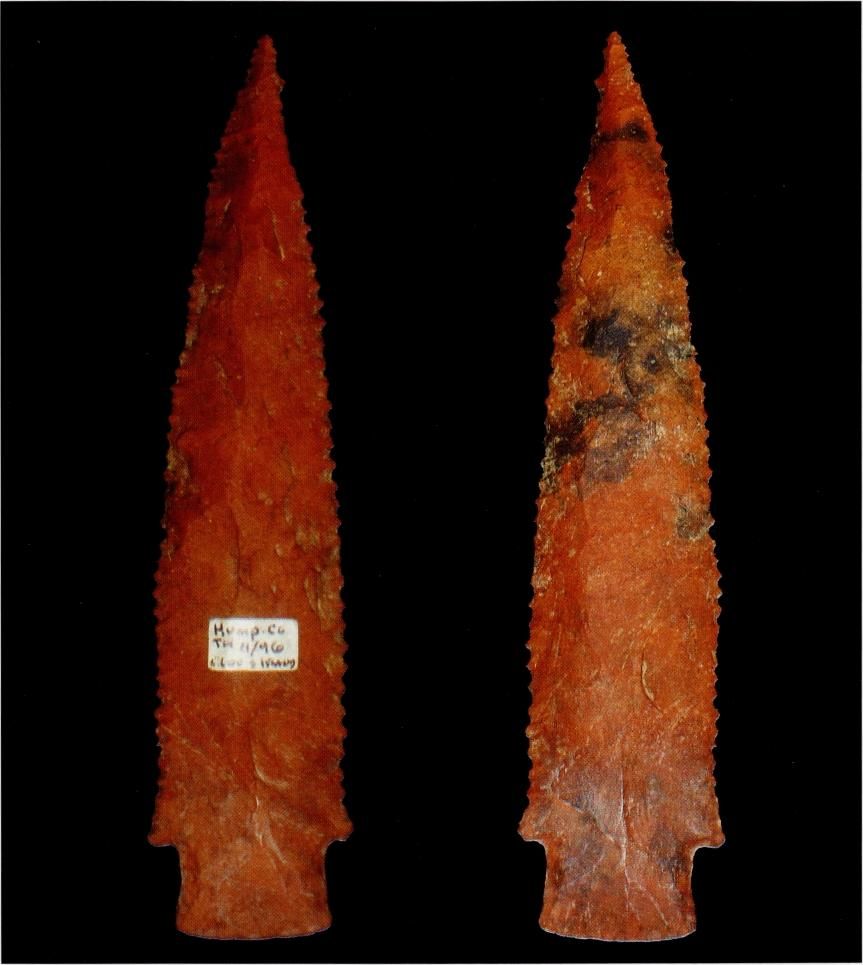
Several years ago, when I first encoun­tered these points, a collector from Smithland, Kentucky, Mark Harris, pointed out how to identify them. He showed me the key is that the point is always steeply beveled on all four sides. However, there are numerous variations in the hafting area and the look of the base. I have seen a few that are highly serrated. Per­haps over time these variations occurred, with the earliest being the examples that have a lanceolate shape. While most are between 2 Y2-3 1/2 inches in length, there are some much larger examples (Figure 3). Most collectors outside of the immediate area of where these are found have rarely seen one.

Fig 1: — A 4″ Harpeth River Point found in Livingston County Kentucky along the Cum­berland River by Rick Travelstead.  Holland Higgs Collection, Cadiz, Kentucky.

Fig 2: — Harpeth River points found on one site located on a creek in Christian County, Kentucky between the years 1995-2000. The site yielded more than 300 Harpeth River Points. Pictured at bottom are more than 100 of those points. The close-up pic­ture at the top is of three from the bottom grouping. The center point is 3 1/2 inches, and has fine serra­tions  Holland Higgs Collection, Cadiz, Kentucky

Fig 3: — Both sides of a very large Harpeth River point. It’s beautiful orange coloring comes from what is commonly called “river stain”. This results from being immersed in the soft soils of a riverbed. This point was found in November 1996 near Clovis landing in Humphreys County Tennessee. It has large serrations, measures 5 3/4 inches in length and is shown full size. Mike Denniston Collection, Kingston Springs, Tennessee “Used by Permission of the Author”
To learn more about or to join the Central States Archaeological Society, click here: CSASI.org

The post The Harpeth River Point appeared first on Arrowheads.com.

Recent Posts

By Kevin Jerome July 24, 2026
Explore the significance of Mississippian pottery trowels. Learn about their use in pottery-making & view our collection.
By tkxkuugb-ca June 29, 2026
Explore the Paleoindian Database for insights on Native American artifacts. Contact us for appraisals & collection support.
By tkxkuugb-ca May 16, 2026
Explore insights on Clovis tools & Scott Ashcraft's whistleblower case. Join the discussion on ethics in archaeology today!
By tkxkuugb-ca April 13, 2026
Learn about miniature Mississippian axe pendants' cultural significance. Contact us for appraisals & to buy authentic artifacts.
By Matt March 25, 2026
Explore the mystery of undrilled bird effigy pipes from TN. Learn about their significance & share your finds with us!
By tkxkuugb-ca March 20, 2026
Tune in to the Seven Ages Podcast to explore the Adena culture, Moundbuilders of the Ohio Valley. Join us for insights on Native American artifacts.
By Arrowheads March 20, 2026
Explore Gary Varient's passion for Native American artifacts. Join the community and share your collection today!
By Matt March 14, 2026
Learn to identify authentic arrowheads vs. reproductions. Consult experts for accurate appraisals and avoid costly mistakes.
By Matt March 3, 2026
Learn about the rare dugout canoe found in the Ohio River. Contact us for artifact appraisal & preservation guidance.
By tkxkuugb-ca February 21, 2026
Learn more about the Paleo American Odyssey in these articles.
Show More