
THE BOSTROM FIGURE PIPE – THE “CAHOKIA CALUMET PIPE”

Share this article

By James E. Marten

The Missouri flint clay figure pipe on the facing page was discovered in Madison County, Illinois in 1955 on a blufftop Mississippian ritual/mortuary site overlooking Cahokia Creek. The ancient channel of this creek flowed past the famous Cahokia Mounds site located several miles downstream to the southwest. Found with this Cahokia effigy style pipe was an unusually well-made and highly polished perforated Cahokia discoidal and an unknown quantity of shell beads. The pipe measures 5 1 /4″ long by 4 1 /8″ wide by 4 1 /8″ tall.

The “Bostrom Figure Pipe” was so named by Thomas E. Emerson in his published report on this pipe, in recognition of Pete Bostrom’s role in bringing this previously unknown find to the attention of the professional community (Emerson, 1983). In his report, Emerson interprets both the large figure and the small recumbent figure as adult male images, the recumbent figure representing a Tennessee-Cumberland depiction as suggested by the rolled hair style.

Recent discovery of the local source of the Missouri flint clay used in the artistic rendering of the Cahokia style figurines and figure pipes suggest 12th century Cahokia as the point of origin. (Emerson, et al, 2000). With this knowledge it seems plausible the larger and more detailed figure portrayed by the Bostrom pipe is a Cahokia personage. Notwithstanding the dominant/subordinate relationship portrayal, the recumbent figure appears to be supported in a gentle manner, not unlike that envisioned in a fictive adoption ritual. Emerson writes:

The nature and distribution of red stone figures in the upper Mississippi River Valley favors a model of exchange operating within the context of politically or socially motivated fictive adoption rituals, as suggested by Hall (1991, 1997).

The same model would likely apply with other trade partners of Cahokia. Hall (1991) makes the case for a “Calumet Ceremony” for early Mississippian times which could logically have been employed in rituals involving Cahokia and its politically subordinate Tennessee-Cumberland and Cairo Lowlands trading partners to the south. He writes:

The Calumet Ceremony was principally an adoption rite to create fictions of blood relationship useful in cementing intertribal relations, and adoption was conceived as rebirth. To the extent that the deeper roots of the Calumet Ceremony were in a mourning ritual, such rebirth amounted to the reincarnation of the person mourned. Red Horn died [in Mississippian mythology], but was returned to life by his sons. His bones were reincarnated.

In consideration of the above, it appears logical to  consider that in early Mississippian times Long Nose God masquettes and tattoos were used to identify participants in a ritual drama involving persons representing the character we know as Red Horn or He-Who-Wears-Human-Heads-As-Earrings and his sons, that this drama was part of an adoption ceremony used to provide a ceremonial relationship between the participants through a fiction of kinship, and that the ceremony was specifically used to establish friendly relations between otherwise unrelated groups.

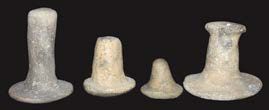
We can only speculate as to the actual purpose served by these artistic masterpieces in flint clay, thought by some to be the renditions of perhaps no more than two Cahokia artisans. Within the prehistoric portrayals set forth above may lie the use and purpose served by the Bostrom Figure Pipe. It is therefore tempting to conclude that the ceremonial smoking of the “Cahokia Calumet Pipe” might have symbolized the handshake by which the economic and socio-political rules of engagement between these peoples were founded.

FINAL NOTE

The Bostom Pipe and accompanying discoidal were collected from the finders by Bob Simons of Fairview Heights, Illinois on the day they were found. He confided this find to only a small group of friends and kept the items from public view in a safe deposit box until 1982 when financial considerations forced the sale to Floyd Ritter of Collinsville, Illinois. The pieces graced Mr. Ritter’s extravagant color case until he recently passed them on to Jim Marlen, in whose collection they now reside.

Recent Posts

By Kevin Jerome July 24, 2026
Explore the significance of Mississippian pottery trowels. Learn about their use in pottery-making & view our collection.
By tkxkuugb-ca June 29, 2026
Explore the Paleoindian Database for insights on Native American artifacts. Contact us for appraisals & collection support.
By tkxkuugb-ca May 16, 2026
Explore insights on Clovis tools & Scott Ashcraft's whistleblower case. Join the discussion on ethics in archaeology today!
By tkxkuugb-ca April 13, 2026
Learn about miniature Mississippian axe pendants' cultural significance. Contact us for appraisals & to buy authentic artifacts.
By Matt March 25, 2026
Explore the mystery of undrilled bird effigy pipes from TN. Learn about their significance & share your finds with us!
By tkxkuugb-ca March 20, 2026
Tune in to the Seven Ages Podcast to explore the Adena culture, Moundbuilders of the Ohio Valley. Join us for insights on Native American artifacts.
By Arrowheads March 20, 2026
Explore Gary Varient's passion for Native American artifacts. Join the community and share your collection today!
By Matt March 14, 2026
Learn to identify authentic arrowheads vs. reproductions. Consult experts for accurate appraisals and avoid costly mistakes.
By Matt March 3, 2026
Learn about the rare dugout canoe found in the Ohio River. Contact us for artifact appraisal & preservation guidance.
By tkxkuugb-ca February 21, 2026
Learn more about the Paleo American Odyssey in these articles.
Show More