
SQUIER & DAVIS RECONSIDERED

Share this article

A BRIEF HISTORY OF AND SELECTED PHOTOS FROM ONE OF THE PREMIER
19TH CENTURY COLLECTIONS OF NORTH AMERICAN ARTIFACTS

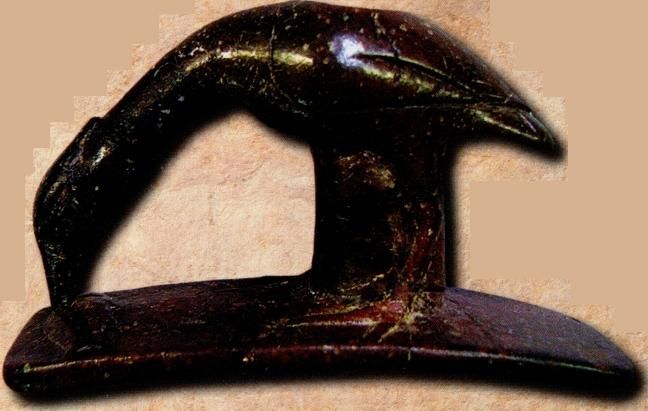
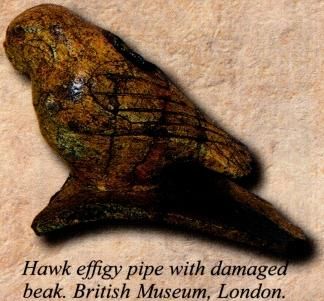
Few North American artifact collections are more fascinating than the one compiled by Dr. Edwin Hamilton Davis and Ephraim George Squier. Their jointly authored book,  Ancient Monuments of  the Mississippi Valley,  was published in 1848, and had the honor of being the first volume of the Smithsonian Institution’s Contributions to Knowledge series. The Smithsonian declined to purchase their collection, Squier and Davis had a serious falling out, and the artifacts were purchased in 1864 by William Blackmore, of Salisbury, England, for $10,000. They were displayed in Salisbury until 1931, and then went to the British Museum. In 2004 the Art Institute of Chicago’s “Hero, Hawk & Open Hand” exhibit included several Hopewell animal effigy pipes from the British Museum.

Ancient Monuments of the Mississippi Valley  was an extraordinary overview of major Native American structures in the Ohio River Valley as they existed in 1848.  The two men conducted excavations on approximately 200 mounds and surveyed close to 100 earth enclosures in the Scioto Valley of southeastern Ohio. Many no longer exist. Their book includes site and artifact engravings, cross section views of mounds showing soil stratigraphy, and descriptions of original and intrusive burials. Some of these engravings are reproduced here.

Squier & Davis gathered over 6,000 objects in and around the mounds and structures they surveyed. The collection in the British Museum consists of 1,300 lots, with up to thirty objects per lot. These artifacts are not limited to Hopewell pieces, butinclude Archaic bannerstones, early Woodland birdstones, Mississippian great pipes, and a host of points, axes, celts, slate gorgets, cache blades, lizard effigies, plumbstones, discoidals, shell beads, obsidian, copper, pearls, mica, and other artifacts.

Perhaps the most extraordinary artifacts found by Squier and Davis came from Mound 8 at Mound City, a thirteen acre site on the Scioto River three miles north of Chillicothe, Ohio.  The site is now part of the Hopewell Culture National Historic Park.  Excavated in 1846, the mound yielded “not far from  two hundred  pipes, carved in stone, many pearl and shell beads, numerous discs, tubes, etc. of copper, and a number of other ornaments of copper covered with silver, etc. etc.” (p.152,  Ancient Monuments of the Mississippi Valley).

This was the largest discovery of Hopewell effigy platform pipes ever recorded. In 1915, William Mills excavated the Tremper Mound, also in Scioto County, Ohio. Mills found 145 intact platform and tubular Hopewell pipes in two caches. These reside today at the Ohio Historical Society Museum in Columbus, Ohio. Many of the Tremper animal effigy pipes bear a strong resemblance to the ones found at Mound City in 1846.

Having just one day to examine the British Museum collection, I requested permission to view and photograph Hopewell and Mississippean pipes, as well as any bannerstones (my personal obsession) in the collection. Fortunately, Ian Taylor, a researcher at the British Museum who worked with me, had out a number of other objects from the collection that I was also able to photograph.

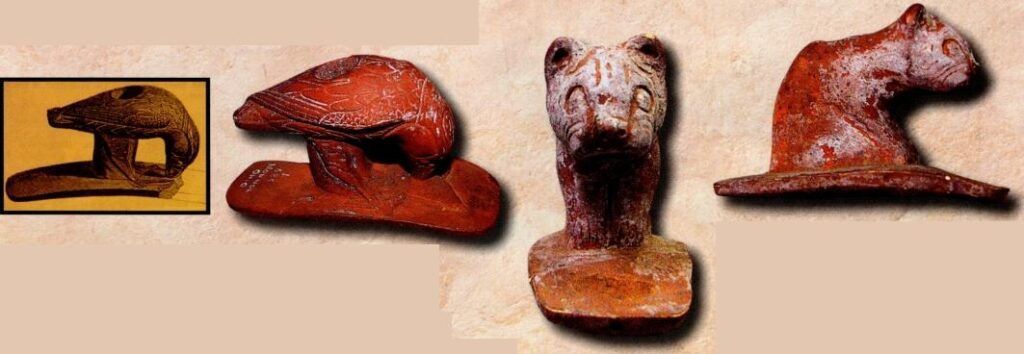
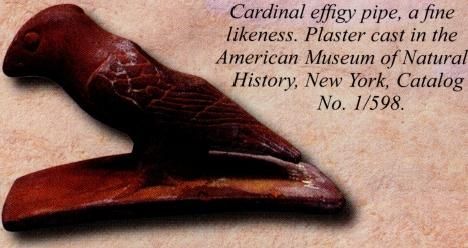
At the American Museum of Natural History, with the help of senior research assistant Anibal Rodriguez, I was able to photograph many of Davis’ plaster casts. This was important as some of the finest pipes in the British Museum are on permanent display inside a glass case, making them impossible to photograph. Flaying seen both the real pipes and their 1850 plaster replicas, I was impressed by the quality of the copies.

Squier & Davis felt that the human pipes were of tremendous importance, offering an accurate portrait of the people whose culture had created them. Proof of this was demonstrated by the exact sculptures on the animal pipes.

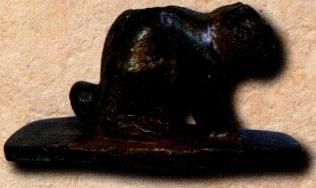
For me, Hopewell animal platform pipes are in a class by themselves. The soul of each animal is clearly caught by the artist. They are as satisfying to look at today as when they were created, 1°,500 years ago.

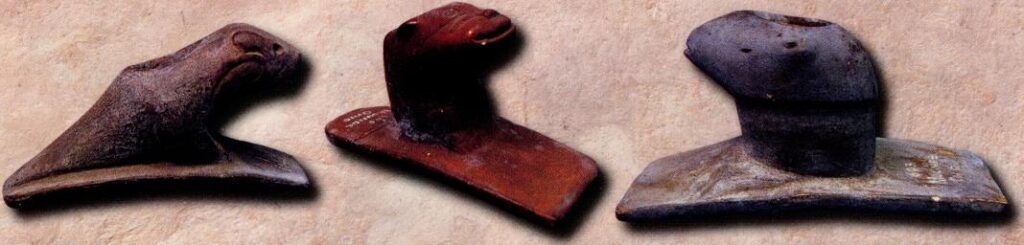
What are they? Squier & Davis felt they represented, from left to right, a manatee, an otter, and finally a fancy piece’
rather than a real animal. William Mills felt the manatee was an otter, The fancy piece’ is considered by some to be
a turtle. Plaster casts in the American Museum of Natural History, New York, Catalog Nos. 1/604, 1/605, 1/603.

I wish to thank the following people who helped make this article possible:

–       Dr. Richard Townsend, Curator, African & Amerindian  Art at the Chicago Art Institute, who gave me an introduction  to the British Museum and much encouragement..  

-Mr. Colin McEwan, Department of Africa, Oceania  and the Americas, British Museum, for permission to  photograph there.  

-Mr. Ian Taylor, Museum Assistant, North American  Collections, British Museum, who kindly spent the day  with me and was very helpful with the Squier & Davis  collection.  

-Dr. David Hurst Thomas, Curator of North American  Archaeology at the American Museum of Natural History, for permission to photograph at the museum. Mr. Anibal Rodriguez, Senior Museum Technician at the American Museum ofNatural History, for his enthusiasm and help with the Squier & Davis pieces.

The post SQUIER & DAVIS RECONSIDERED appeared first on Arrowheads.com.

Recent Posts

By Kevin Jerome July 24, 2026
Explore the significance of Mississippian pottery trowels. Learn about their use in pottery-making & view our collection.
By tkxkuugb-ca June 29, 2026
Explore the Paleoindian Database for insights on Native American artifacts. Contact us for appraisals & collection support.
By tkxkuugb-ca May 16, 2026
Explore insights on Clovis tools & Scott Ashcraft's whistleblower case. Join the discussion on ethics in archaeology today!
By tkxkuugb-ca April 13, 2026
Learn about miniature Mississippian axe pendants' cultural significance. Contact us for appraisals & to buy authentic artifacts.
By Matt March 25, 2026
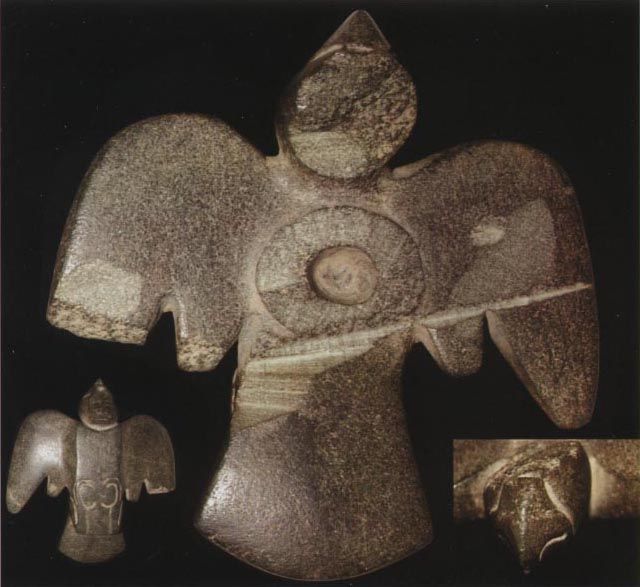
Explore the mystery of undrilled bird effigy pipes from TN. Learn about their significance & share your finds with us!
By tkxkuugb-ca March 20, 2026
Tune in to the Seven Ages Podcast to explore the Adena culture, Moundbuilders of the Ohio Valley. Join us for insights on Native American artifacts.
By Arrowheads March 20, 2026
Explore Gary Varient's passion for Native American artifacts. Join the community and share your collection today!
By Matt March 14, 2026
Learn to identify authentic arrowheads vs. reproductions. Consult experts for accurate appraisals and avoid costly mistakes.
By Matt March 3, 2026
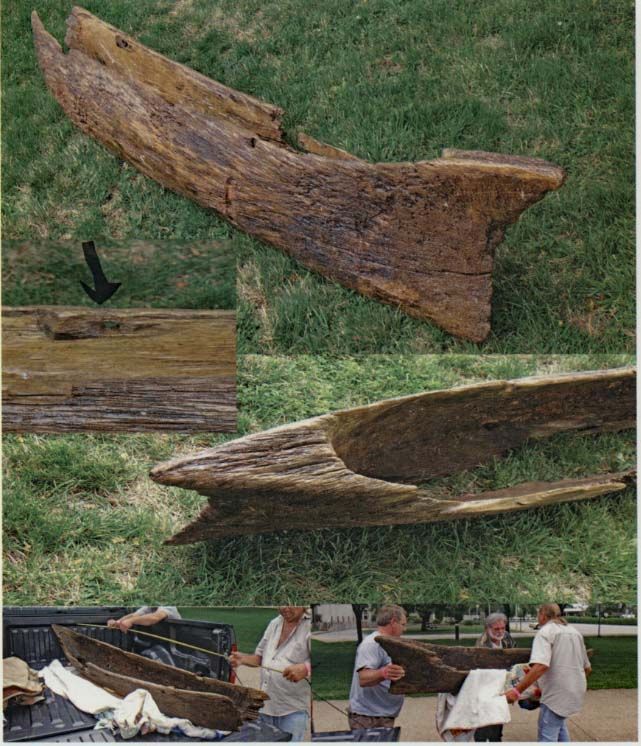
Learn about the rare dugout canoe found in the Ohio River. Contact us for artifact appraisal & preservation guidance.
By tkxkuugb-ca February 21, 2026
Learn more about the Paleo American Odyssey in these articles.
Show More