
Introduction – Bannerstones

Share this article

by

Charlie Wagers, Fairfield, Ohio

This issue of Prehistoric American is dedicated to the  bannerstone , a prehistoric artform which captures the imagination and love of most all artifact collectors.  The bannerstone probably comes in a wider variety of forms and materials than any other prehistoric artifact type.  They are found made from the most beautiful quartz to the most drab sandstone.  Their from aries from their highly-developed double crescent to examples that are little more that a drilled pebble.  From the number of salvaged examples and reworked froms, they were undoubtedly highly regarded by their owners.

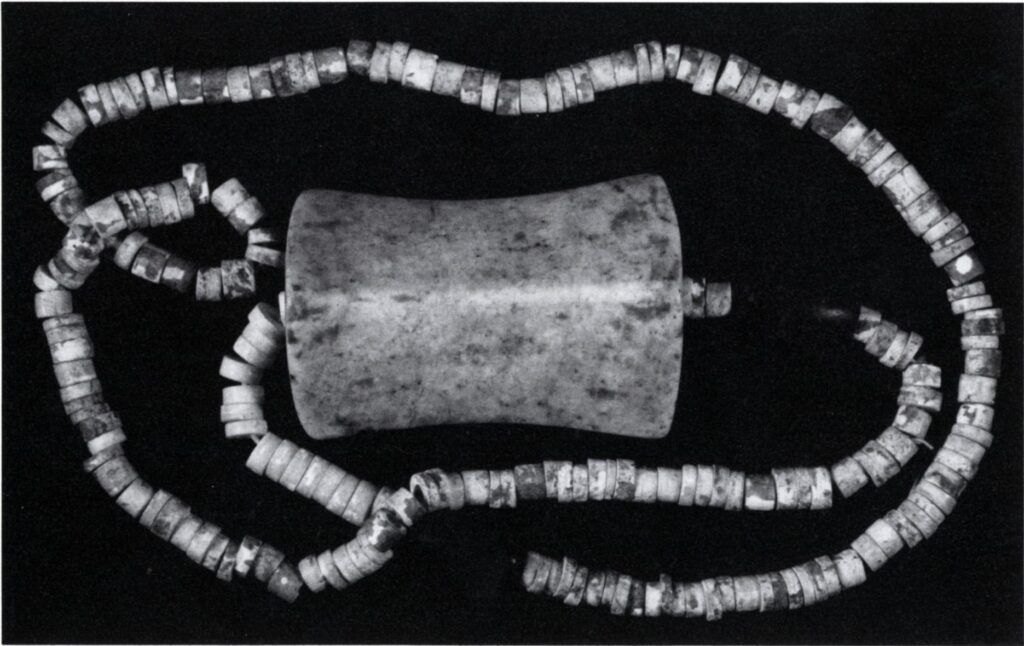
Speculation has bounced around for years on what was their actual use.  Moore was convinced that the examples found along the Green River in Kentucky were net spacers and that the hooks often found with them were hooks used in the manufacture of nets.  Dr. W. S. Webb spoofed at this theory claiming they were spear thrower or atal atal weights.  He based his theories upon excavations at Indian Knoll in Ohio County, Kentucky.  It is interesting to note here that there was an example found at Indian Knoll which was a beautiful quartz saddle form on a necklace of shell beads.  In this issue, Bill Koup and David Lutz present their thoughts and studies on the subject.

The writer speculates that the term “bannerstone” is applied to a form which had a variety of purposes and uses. There is little question in my mind that some were used for atal atal weights. It seems curious that so much effort would be placed into a beautiful quartz banner to use it on a tool as utilitarian as a spear thrower. It also seems curious that beautiful quartz examples are found which show no use and seem to have been made to be buried, yet have the same form and are found on the same sites as those associated with spear throwers. Likewise, this writer cannot believe that the highly developed slate forms like the double crescents, notched ovates, reels, and butterflies would have been used as a spear thrower weight. Further, I know of no situation in which these forms have been found with a hook or other association suggesting an atal atal weight. It is more probable that these forms were mounted for use as a sceptre or symbol of position.

A very unusual find was this beautiful quartz banner found with the beads as if to form a necklace. This was found on the Indian Knoll Site in Ohio Co., Ky.

Article used with permission by Bill Koup

The post Introduction – Bannerstones appeared first on Arrowheads.com.

Recent Posts

By Kevin Jerome July 24, 2026
Explore the significance of Mississippian pottery trowels. Learn about their use in pottery-making & view our collection.
By tkxkuugb-ca June 29, 2026
Explore the Paleoindian Database for insights on Native American artifacts. Contact us for appraisals & collection support.
By tkxkuugb-ca May 16, 2026
Explore insights on Clovis tools & Scott Ashcraft's whistleblower case. Join the discussion on ethics in archaeology today!
By tkxkuugb-ca April 13, 2026
Learn about miniature Mississippian axe pendants' cultural significance. Contact us for appraisals & to buy authentic artifacts.
By Matt March 25, 2026
Explore the mystery of undrilled bird effigy pipes from TN. Learn about their significance & share your finds with us!
By tkxkuugb-ca March 20, 2026
Tune in to the Seven Ages Podcast to explore the Adena culture, Moundbuilders of the Ohio Valley. Join us for insights on Native American artifacts.
By Arrowheads March 20, 2026
Explore Gary Varient's passion for Native American artifacts. Join the community and share your collection today!
By Matt March 14, 2026
Learn to identify authentic arrowheads vs. reproductions. Consult experts for accurate appraisals and avoid costly mistakes.
By Matt March 3, 2026
Learn about the rare dugout canoe found in the Ohio River. Contact us for artifact appraisal & preservation guidance.
By tkxkuugb-ca February 21, 2026
Learn more about the Paleo American Odyssey in these articles.
Show More