
Hafting Strategies for Knife Utilization in the Clovis Tradition

Share this article

by Greg L. Moore, D VM, Rhome, Texas

Originally Published in the Central States Archaeological Journal, Vol.56, No.4, pg.200

Originally Published in the Central States Archaeological Journal, Vol.57, No.1, pg.30

As most of us have come to realize with the more artifacts we handle, I have concluded that the majority of artifacts were probably utilized as tools and not as projectiles. Af­ter all, it is just common sense. Would I have thrown more lances or darts with projectiles or relied on scrapers, knives, choppers, drills and other tools in a normal day? When I open the drawer in our kitchen to retrieve a knife, I have many types to choose from depending on the use I want to accomplish with it. This selection of blades and handles in fact are log­ically sold as a set often inserted into a nice wooden block to be placed on the counter for easy acquisition.

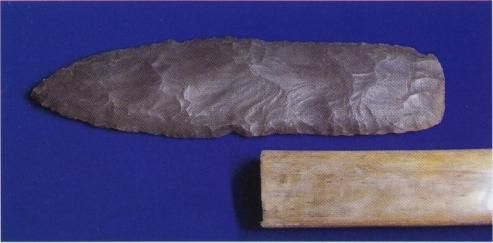
When I look at an assortment of bifaces, pre­forms and projectiles from the Clovis Tradi­tion, I began to see the “wooden block” and its various knives ready for use. As I have stated in previous articles, I do not believe that any­thing went to waste. I believe that large flaked cobbles were used as heavy choppers, that re­duction flakes were utilized as limaces, flake knives, scrapers and even projectiles. With further reduction came large bifaces that were either hand held or wrapped on one end with animal hide to form a handle (figure 1 above). Further reduction of the blade would then see the biface setup for fluting while it was large and less likely to result in failure as the flute was struck.

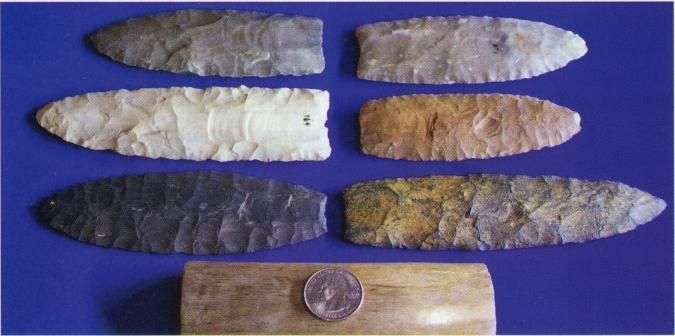
At this point, the fluted biface was large and at times crude when compared to the fine fin­ished Clovis projectile. With the blades inser­tion onto a handle, it became a well balanced large knife Large blades required more of the surface area to be included in the haft therefore transferring stress, like the shank of modern day knives, to the handle in an attempt to re­duce blade fracture (figure 2 below). Because of its importance, I believe it is the handle that was the more prized of the two components. After all, many blades came and went but the handle, if of durable material, could last for years. The handle could retain information of the owner’s accomplishments by way of in­scribing or tallies and could represent some component or belief of luck or success.

By comparing the similar widths of these large early fluted bifaces, I suggest that some similar material was used for the handle al­most universally throughout the Clovis Tradi­tion. Just like the consistent construction of the Clovis projectile across North America, so too could be the handle in its type, construc­tion and hafting. This could make Clovis tools and materials interchangeable among clans. A standardized handle would call for a standard­ized blade width for insertion and would stan­dardize the reduction process of the biface. For this article, I have used Pleistocene mam­moth rib to construct the handles which are durable and ergonomic in the hand.

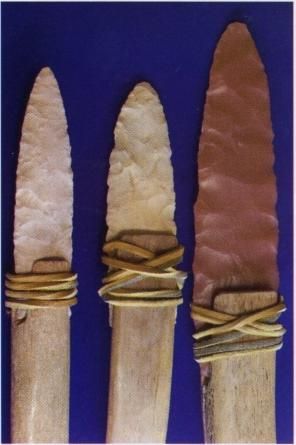
Blade replacement would be easily ac­complished taking only a few minutes to un­lash the reduced blade and insert the new one. The reduced blade would now be rebased and possibly additionally fluted to fit into the next smaller knife handle (figure 3 below),Inser­tion and binding could be accomplished in just minutes. Again, there appears to be a standard width for these smaller knife blades when you compare large numbers of fluted artifacts that seem too long and thin for projectiles and use wear suggests the blade was used as a knife. As these smaller knives were reduced from resharpening, they could again be rebased and finely flaked into deadly projectiles. This could explain some of the extensive use polish and very fine retouch seen on the base of many Clovis projectile points. Closer inspection on some Clovis projectiles will even retain evidence of previous hafting on the blade face when the blade was longer, prior to its current reduction (figure 4).

Figure 3: Please note:  The largest blade pictured is a cast from the Fenn Cache.  The middle blade, almost exhausted from a larger blade like the Fenn blade, is ready to be rebased and placed on the next smaller handle with a shorter haft as shown lower in the picture.  The middle blade was found near Tyler, Texas and the lower Clovis was found in Ralls Co. MO.

 Figure 4.

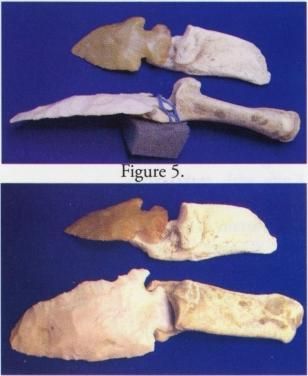
Although we will never know exactly how these artifacts were utilized, I believe that some type of “manufacturing standard” was in play even throughout most time periods and cultures. The last example I’ve pictured shows two knives and handles found under an overhang near the opening of a small cave by a friend of mine. It demonstrates the ease at which the blade could be attached to the han­dle and a consistency in manufacture of the blade and the handle type. Like many Late Ar­chaic and Woodland period artifacts, the blade stem is offset to one blade face more than the other which allows a flat haft when secured to the bone handle and its angled protuberance in relation to the flat plain of the handle (fig­ures 5 & 6 below). Although not of the Clo­vis Tradition, it is useful to demonstrate that the blade and hafting area was shaped to fit a “standard” handle and the intended use was that of a knife and not a projectile.

Figure 6. (bottom)

 “Used by Permission of the Author”
To learn more about or to join the Central States Archaeological Society, click here: CSASI.org

Recent Posts

By Kevin Jerome July 24, 2026
Explore the significance of Mississippian pottery trowels. Learn about their use in pottery-making & view our collection.
By tkxkuugb-ca June 29, 2026
Explore the Paleoindian Database for insights on Native American artifacts. Contact us for appraisals & collection support.
By tkxkuugb-ca May 16, 2026
Explore insights on Clovis tools & Scott Ashcraft's whistleblower case. Join the discussion on ethics in archaeology today!
By tkxkuugb-ca April 13, 2026
Learn about miniature Mississippian axe pendants' cultural significance. Contact us for appraisals & to buy authentic artifacts.
By Matt March 25, 2026
Explore the mystery of undrilled bird effigy pipes from TN. Learn about their significance & share your finds with us!
By tkxkuugb-ca March 20, 2026
Tune in to the Seven Ages Podcast to explore the Adena culture, Moundbuilders of the Ohio Valley. Join us for insights on Native American artifacts.
By Arrowheads March 20, 2026
Explore Gary Varient's passion for Native American artifacts. Join the community and share your collection today!
By Matt March 14, 2026
Learn to identify authentic arrowheads vs. reproductions. Consult experts for accurate appraisals and avoid costly mistakes.
By Matt March 3, 2026
Learn about the rare dugout canoe found in the Ohio River. Contact us for artifact appraisal & preservation guidance.
By tkxkuugb-ca February 21, 2026
Learn more about the Paleo American Odyssey in these articles.
Show More