
EAST WENATCHEE CLOVIS SITE

Share this article

By Leslie S. Pfeiffer, Associate Editor

On May 27, 1987, farm worker Moses Aguirre was digging a trench for irrigation pipe in an apple orchard owned by Dr. Mack Richey near East Wenatchee, Washington. This is in central Washington, just east of the Columbia River. His shovel hit something hard, and the two ends of a large Indian artifact popped out of the ground. This Clovis point was the beginning of the discovery of an important and unique Clovis cache.

Clovis artifacts are extremely rare in the Northwest, and this site boasts several “firsts”. This was the first Clovis cache to be found  in situ;  two of the Clovis points are the largest and finest Clovis points known; and the bone rods (13 were found!) are almost unheard of outside those found in the Florida rivers, because of degradation.

Moses, digging with his hands, removed 24 points, all lying tightly together. He showed them to the ranch foreman, Rich Roberts. Rich’s wife, Joanne, went to the local library to research the points, read about Clovis points, and contacted a local retired doctor, Russell Congdon. He then contacted Robert Mierendorf, a staff archaeologist at North Cascades National Park.

Congdon and Mierendorf went to the site on August 16, 1987 and, following out the hole Moses Aguirre had dug, found a 5 ‘/2″ Clovis, three celts, and three bone rods. They filled the pit back in, leaving the artifacts in place. Robert Mierendorf named the site the East Wenatchee Clovis Site, and it was designated site 45-DO-432 by the State of Washington.

Peter Mehringer of Washington State University was brought in, and he reached agreement with Dr. Richey to excavate the site, now renamed the Richey-Roberts Clovis Cache. On April 8, 1988, Dr. Mehringer’s excavation began with a 35 square meter block. They found 22 more stone and bone Clovis tools, bringing the total to 46. Only 5 of the artifacts were removed for study. Volcanic ash from under the artifacts was dated at 13,200 years ago.

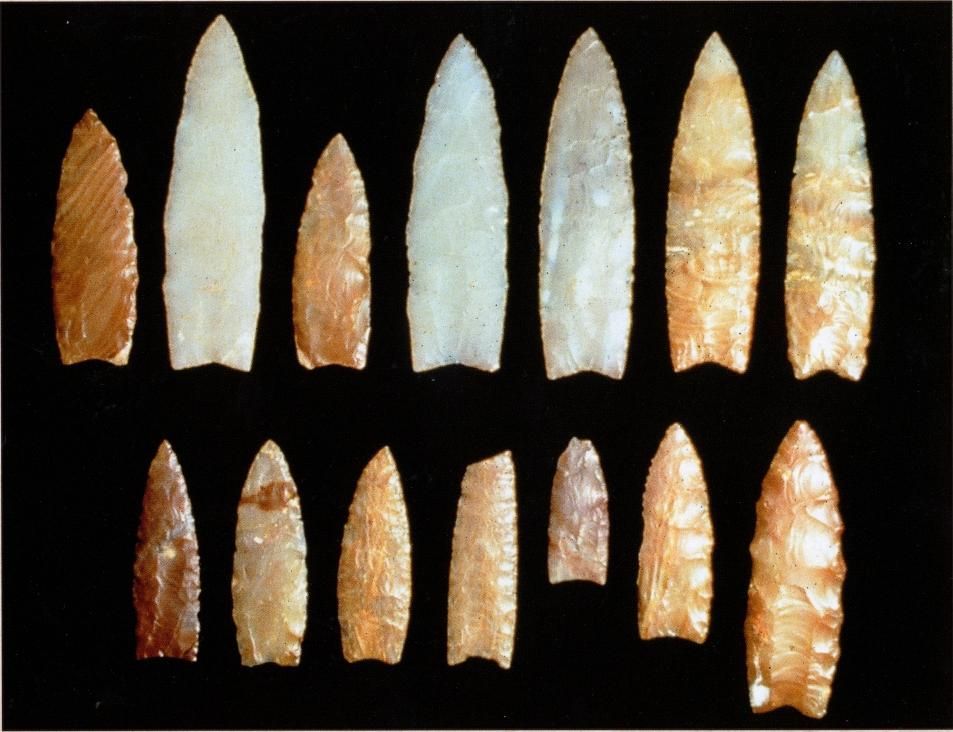
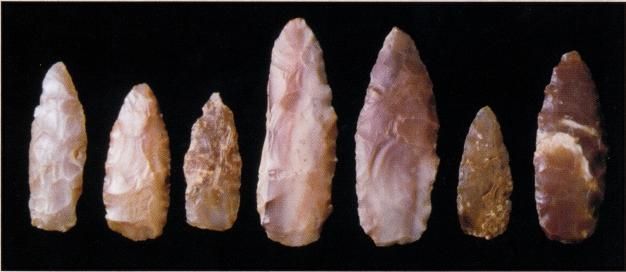
Pictured here are fourteen of the Clovis points, and the cache is famous for the very large points. Five of the points are over 8″ in length, and two are over 9″ in length. I was lucky to have the chance to handle the points at Pete Bostrom’s house when he was photographing them, and the two largest ones are the most spectacular Clovis points this author has ever seen, for their size, material, and workmanship. This picture shows all fourteen of the fluted points in the Richey/Roberts cache. The materials are various forms of semi-translucent agates and chalcedony. (Washington State Historical Society Museum Collection; photo by Dr. Mike Gramly)

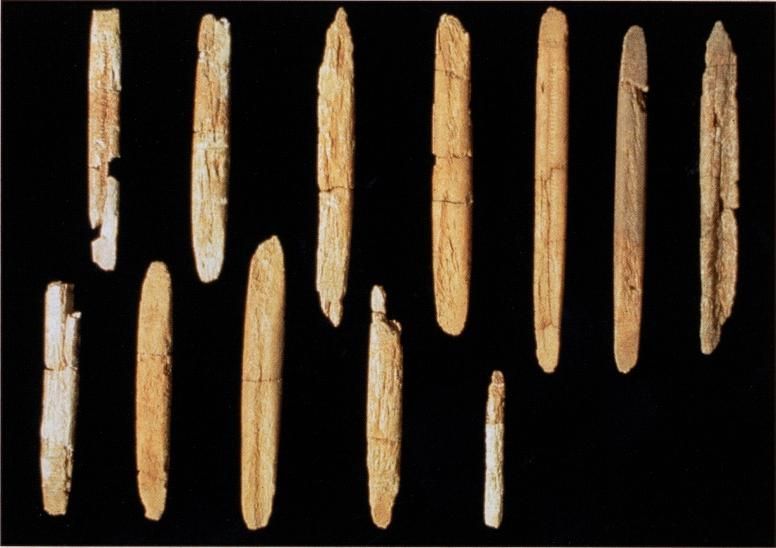
Some of the most important artifacts found on the Richey/Roberts site are these beveled bone rods (the longest is 11″ long). This picture shows the twelve that were removed from the excavation. A thirteenth specimen was left in situ and has not been removed. Some theories for their use range from sled runners, to flintknapping tools, to foreshafts. Further discoveries may be needed in order to fully understand their function. They are, however, part of a compound technology typical of highly mobile and nomadic hunters. (Washington State Historical Society Museum Collection; photo by Dr. Mike Gramly)

Next, Dr. Richard M. Gramly of the Buffalo, New York Museum of Science was brought in. With much disagreement between almost everyone involved, and under protest from the local Colville Indian Tribe, Dr. Gramly began his excavation on October 22, 1990 and finished on November 17. He removed and catalogued 47 artifacts. Included in this total are the artifacts uncovered by Dr. Mierendorf in the original hole.

The artifacts are now on display in Tacoma at the Washington State History Museum. A 15-year moratorium on excavating the site ended June 1, 2007, but it is highly unlikely that the Colville Indian tribe will ever allow the site to be opened again.

The most important find at East Wenatchee is the cache of 13 bone rods made of proboscidean (mammoth or mastodon) limb bones. While there is no doubt that the Clovis people used mammoth bone in many ways, including bone points, the best hypothesis is that these bone rods were likely foreshafts to mount stone points to wood shafts.

Dr. Gramly wrote an important monograph in 1993 entitled  The Richey Clovis Cache,  and following are observations he made in it.

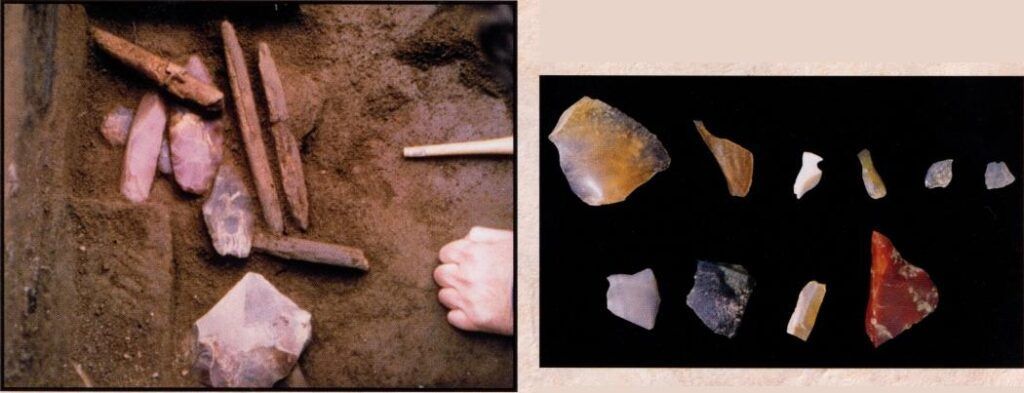
Artifact mass near the bottom of an ancient pit. Visible  are two fluted point preforms, a bifacial knife, a sidescraper,  and a blank or large, unmodified flake. In addition, portions  of five beveled rods fashioned of bone may be seen. Photo  by Dr. Mike Gramly.

Miscellaneous small finds from the pit feature at the East Wenatchee Clovis site. The top group shows representative flakes of various raw materials. The bottom group includes micro-tools (left) and a corner broken off a large biface (right) that does not fit any other object from the feature.  76  Photo by Dr. Mike Gramly.

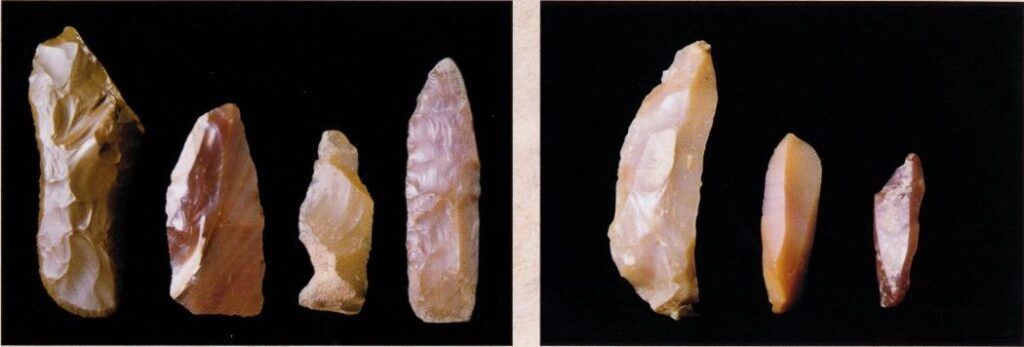
Sidescrapers from the pit feature at the East Wenatchee Clovis site. The two specimens in the center have possible blood residue. Photo by Dr. Mike Gramly.

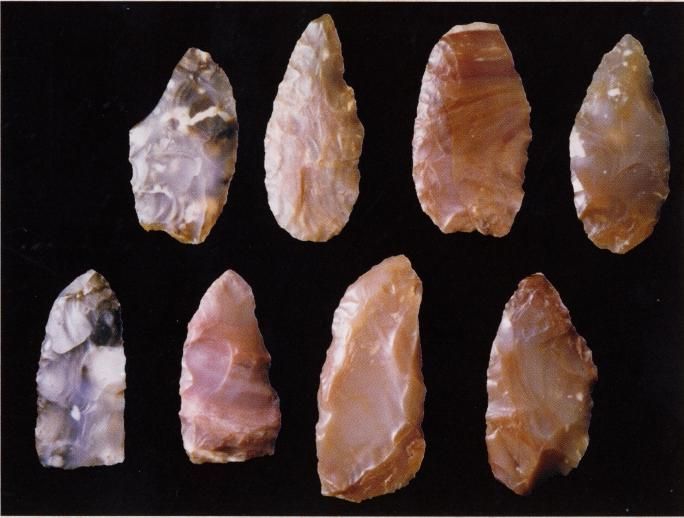
All the fluted point preforms from the pit feature at the East Wenatchee Clovis site. All bear blood residues along cutting edges, suggesting use as knives or cleavers. Photo by Dr. Mike Gramly that is present on nearly all tools. Positive reactions  were obtained for bison, deer family (caribou, deer,  moose), and lagomorphs (hares, rabbit, and pikas).  Human blood was also detected on the largest fluted point where a handle would have been.

The Richey bone implements are rods  of dense, hind leg bone of mammoth or mastodon. Their average length is 25 cm. Both ends were carefully beveled by grinding, and the flat faces of these bevels have been roughened by scratching—perhaps for secure hafting. Decorated Clovis artifacts are exceedingly rare and until now were only known from derived, secondary contexts. The function of the bi-beveled bone rods can only be guessed. It is notable that the rods are paired by size.  Fitted together at their beveled ends and  bound with sinew, a set of seven rods would  have measured approximately 1.4 meters. It is  remarkable that the length of the pit in which they were found is 1.5 meters. I do not believe that this correspondence is coincidental. The  existence of the Richey Cache implies that hunters abandoned the East Wenatchee site  but expected to return in the near future,  perhaps after a season. The bison blood on their butchering tools indicates that during  some period of their annual round, the Clovis  group waylaid these formidable creatures. Not surprisingly, the Clovis camp faces one of the easiest routes for reaching the top of the Columbia Plateau. Animals ascending or descending the slope may have been ambushed by waiting hunters.

Recent Posts

By Kevin Jerome July 24, 2026
Explore the significance of Mississippian pottery trowels. Learn about their use in pottery-making & view our collection.
By tkxkuugb-ca June 29, 2026
Explore the Paleoindian Database for insights on Native American artifacts. Contact us for appraisals & collection support.
By tkxkuugb-ca May 16, 2026
Explore insights on Clovis tools & Scott Ashcraft's whistleblower case. Join the discussion on ethics in archaeology today!
By tkxkuugb-ca April 13, 2026
Learn about miniature Mississippian axe pendants' cultural significance. Contact us for appraisals & to buy authentic artifacts.
By Matt March 25, 2026
Explore the mystery of undrilled bird effigy pipes from TN. Learn about their significance & share your finds with us!
By tkxkuugb-ca March 20, 2026
Tune in to the Seven Ages Podcast to explore the Adena culture, Moundbuilders of the Ohio Valley. Join us for insights on Native American artifacts.
By Arrowheads March 20, 2026
Explore Gary Varient's passion for Native American artifacts. Join the community and share your collection today!
By Matt March 14, 2026
Learn to identify authentic arrowheads vs. reproductions. Consult experts for accurate appraisals and avoid costly mistakes.
By Matt March 3, 2026
Learn about the rare dugout canoe found in the Ohio River. Contact us for artifact appraisal & preservation guidance.
By tkxkuugb-ca February 21, 2026
Learn more about the Paleo American Odyssey in these articles.
Show More