
A South Carolina Southern Raised Ridge Axe

Share this article

by Billy Abee, Union, South Carolina

Originally Published in the Central States Archaeological Journal, Vol.56, No.4, pg.200

Originally Published in the Central States Archaeological Journal, Vol.57, No.2, pg.100

This report is a recording of one of the fin­est and rarest axe type found in South Carolina, A large Southern Raised Ridge Axe. Description, size, lithic material, and history of the discovery are given.

Stone axes have long been considered one the major characteristic artifact types of the Archaic Period. We know that there are hundreds of thou­sands of stone axes that have been found in North America consisting of about a dozen basic styles. Stone axes are an invaluable tool to the archaeolo­gist interpreting the lives of the American Indian in their daily life; however, most of the research done in regards to stone axes has been done by amateurs and collectors, and not by professional archaeologists. Regrettably, not much can be said concerning the specific aspects of any cultural identification other than that the Southern Raised Ridge Axe dates to the Archaic Period, which puts these Indians in the categorical group of hunters and gatherers.

In the beginning every American Indian prob­ably manufactured his own axe; however, as his material culture advanced in some areas, there can be little doubt that men of greater skills and patience (probably elderly men) specialized in the manufacturing of axes and other necessities and traded them to others for food, furs, and other tools.

The three-quarter axe dates to the late Archaic Period, from about 3,000 BC to the time of Christ, while the full groove axe dates from about 6.000 BC to 3,000 BC. The sites that produce this type of axe vary in function from very large base settle­ments to small hunting and transient camps. Fre­quently, all that remains today of these archaic sites are scattered fire —broken rocks, projectile points, scrapers, knives, axes, atlatl weights (ban­nerstones), and sherds from steatite vessels. Very few axes have been found in controlled excava­tions, for most have been found as surface finds in plowed fields.

One of the most important aspects of stone axe studies is the identification of the different lithic material that were used in their manufacture, and locating the potential sources of the material.  The most common materials are quartz diorite, dif­ferent type of granite, and greenstone.

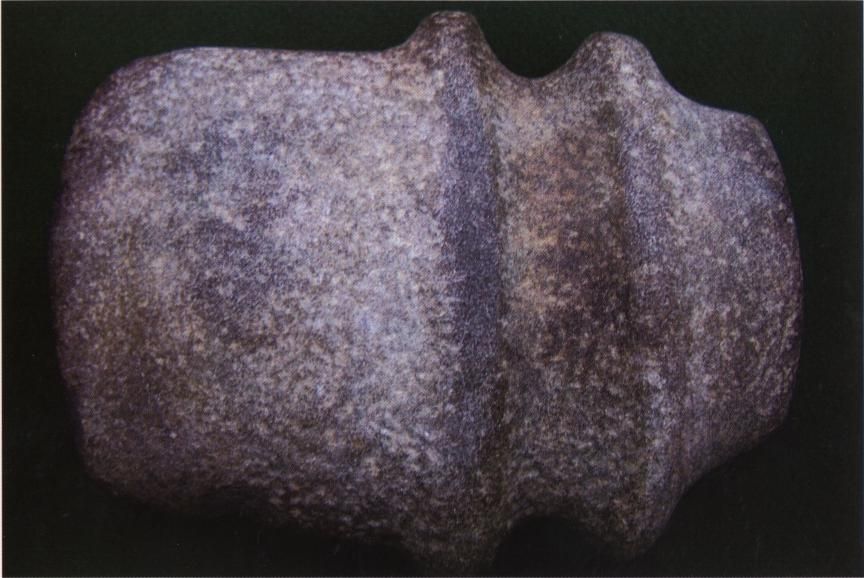
At top: An extremely large, well made Southern Raised Ridge axe from Union County, South Carolina. It is 9 inches long, 6 1  inches wide, 2 1 /4 inches thick and weighs 6 pounds, 2 ounces. Material is a fine grained granite.

The manufacturing process of groove axes is that the Indian would look in local riverbeds for a natural stone a little larger than needed to pro­duce an axe. He then would pick and hammer the basic shape he desired. Then he would form the bit end and ground a groove where he needed it to be to balance the axe when hafted. Last he would ground the axe smooth then polish it to suit his personal taste.

The Southern Raised Ridge Axe type is one of the most stylized of the many thousands of axes found east of the Appalachian Mountains and has a limited distribution along the foothills in Ten­nessee, southeastern Virginia, North Carolina, and South Carolina.

The raised ridge around both sides of the groove testifies to the fact that the original block of stone from which these axes were made from was at least as wide and as thick as the raised ridges indicate. This demonstrates how much pecking and grind­ing was needed to reduce the width and thickness of the blade while leaving the raised ridges intact. This type of stone reduction greatly increased the time and labor necessary to manufacture an axe of the style.

The Southern Raised Ridge Axes will vary in size from six to about ten inches in length, with about seven to eight inches being average. All examples will have a well defined deep hafting groove sporting two distinctive ridges around the circum-ference of the axe. The axe will always be full groove and may or may not show heavy use. The butt or poll end is usually square; however, some examples with round or pointed poles have been recorded.

The South Carolina Raised Ridge Axe shown in the accompanying picture was recovered near the Tyger River in Tuckertown, Union County, South Carolina. The axe was found by an African American man plowing a field in the late 1920’s or early 1930’s about 1/4 mile below the Gordon’s Bridge on the Tyger River (between Union and Newberry County, South Carolina). It was sold to Walt Stevens of Union County, South Carolina in 1938. Walt traded a piece of furniture for it. The man whom Walt purchased it from was using it as a doorstop in his two room house, in which he raised twelve children. At Walt’s death in 1978, he willed the axe to Billy Abee of Union County, S.C. Billy was contacted by Walt’s wife three or four days after the passing of Walt to come and pick up the axe.

The axe has been recorded and registered at the Archaeological and Anthropological Department of the University of Carolina, South Carolina, by Tommy C. Charles. This Southern Raised Ridge Axe is the finest one of its type recorded in South Carolina. It is 9 inches in length, 6 1/2 inches wide, 2 1/4 inches thick, and weighs 6 pounds, 2 ounces. Material is slightly weathered fine-grained gran­ite.

This Early Archaic Dalton-Hemphill point was a surface find in Franklin County, Arkansas by Gerald Barbour in the Summer of 2000. It is four inches in length and made from Burlington chert.  Collection of Gerald Barbour, Ozark, Arkansas. “Used by Permission of the Author”
To learn more about or to join the Central States Archaeological Society, click here: CSASI.org

Recent Posts

By Kevin Jerome July 24, 2026
Explore the significance of Mississippian pottery trowels. Learn about their use in pottery-making & view our collection.
By tkxkuugb-ca June 29, 2026
Explore the Paleoindian Database for insights on Native American artifacts. Contact us for appraisals & collection support.
By tkxkuugb-ca May 16, 2026
Explore insights on Clovis tools & Scott Ashcraft's whistleblower case. Join the discussion on ethics in archaeology today!

By tkxkuugb-ca April 13, 2026
Learn about miniature Mississippian axe pendants' cultural significance. Contact us for appraisals & to buy authentic artifacts.
By Matt March 25, 2026
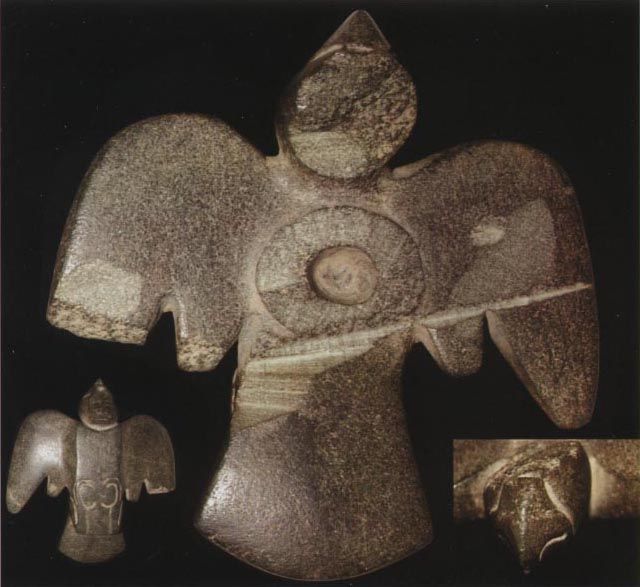
Explore the mystery of undrilled bird effigy pipes from TN. Learn about their significance & share your finds with us!
By tkxkuugb-ca March 20, 2026
Tune in to the Seven Ages Podcast to explore the Adena culture, Moundbuilders of the Ohio Valley. Join us for insights on Native American artifacts.
By Arrowheads March 20, 2026
Explore Gary Varient's passion for Native American artifacts. Join the community and share your collection today!
By Matt March 14, 2026
Learn to identify authentic arrowheads vs. reproductions. Consult experts for accurate appraisals and avoid costly mistakes.
By Matt March 3, 2026
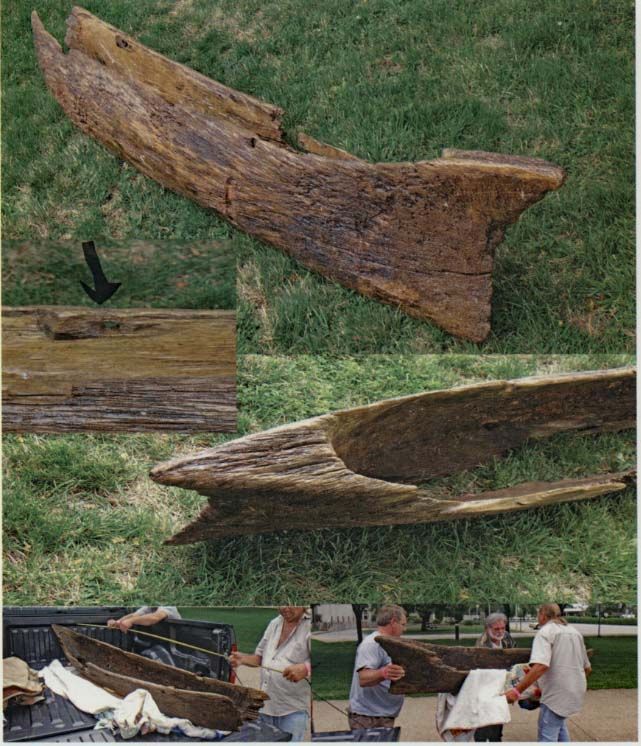
Learn about the rare dugout canoe found in the Ohio River. Contact us for artifact appraisal & preservation guidance.
By tkxkuugb-ca February 21, 2026
Learn more about the Paleo American Odyssey in these articles.
Show More