
A Brief Note on the Texas Early Triangle Type

Share this article

Central States Archaeological Societies 2012 July Journal   by Malcolm T. McLaughlin, Aurora CO.

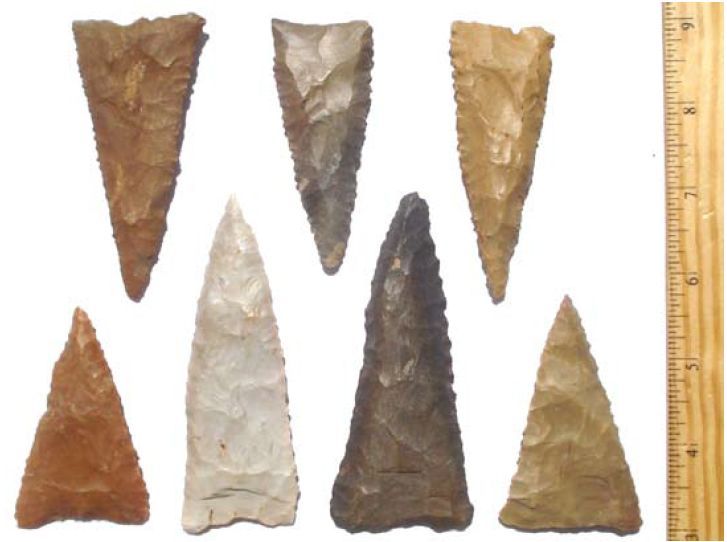
 Figure 1. Early triangles with triangular blades.

 The Texas Early Triangle is an artifact type found predominantly in Central Texas and also occasionally in West Texas. These artifacts are dated to approximately 5700 years ago, placing them near the transition from the Early Archaic period to the Middle Archaic period in Central Texas. The Early Triangle type is described by Ellen S. Turner and Thomas R. Hester in A Field Guide to Stone Artifacts of Texas Indians. Early Triangles do not have stems or notches for hafting to an atlatl fore shaft, suggesting they were probably used as knives or cutting tools.

 Early Triangles are fascinating artifacts, because they display traits that are considered highly desirable by many collectors. Specifically, most Early Triangles have a distinctive combination of basal fluting or thinning, steep bevel blade resharpening, and prominent serrations that appear along the blade edge throughout the life of the artifact. These characteristics are considered desirable by many collectors because they reflect techniques applied in the construction of projectile points from the Paleo and Early Archaic periods, and also because they provide great visual appeal.

 Twelve Early Triangles were reviewed for this Note, eleven of the examples were found in Coryell, Hamilton and Bell Counties in Central Texas, and one example was found in West Texas. The studied examples vary in length from 52mm to 100mm, but have remarkably consistent basal widths between 33 and 38mm. This suggests that Early Triangles are often constructed with initial length to- width ratios of around 3:1. Over time, several of the examples were resharpened until they reached length to- width ratios of less than 2:1, creating steep bevels on the blade edges.

 Early Triangles display two curious traits related to the resharpening process. First, the type can be separated into sub-groups, one representing resharpened examples with truly triangular blades (Figure 1) and the other representing examples with recurved blades (Figure 2). Most examples in both categories display basal fluting or thinning and prominent serrations. Second, the process of bevel resharpening is inconsistent across examples. Some are beveled on the right side of the blade, while others are beveled on the left side of the blade; some are even beveled on both sides of the blade. These traits highlight significant diversity within the point type. 

 References:
Turner, Ellen S., and Hester, Thomas R.
1993. A Field Guide to Stone Artifacts of Texas Indians, Gulf Publishing
Perttula, Timothy K.
2004. The Pre-History of Texas, Texas A&M University Publishing

Recent Posts

By Kevin Jerome July 24, 2026
Explore the significance of Mississippian pottery trowels. Learn about their use in pottery-making & view our collection.
By tkxkuugb-ca June 29, 2026
Explore the Paleoindian Database for insights on Native American artifacts. Contact us for appraisals & collection support.
By tkxkuugb-ca May 16, 2026
Explore insights on Clovis tools & Scott Ashcraft's whistleblower case. Join the discussion on ethics in archaeology today!
By tkxkuugb-ca April 13, 2026
Learn about miniature Mississippian axe pendants' cultural significance. Contact us for appraisals & to buy authentic artifacts.
By Matt March 25, 2026
Explore the mystery of undrilled bird effigy pipes from TN. Learn about their significance & share your finds with us!
By tkxkuugb-ca March 20, 2026
Tune in to the Seven Ages Podcast to explore the Adena culture, Moundbuilders of the Ohio Valley. Join us for insights on Native American artifacts.
By Arrowheads March 20, 2026
Explore Gary Varient's passion for Native American artifacts. Join the community and share your collection today!
By Matt March 14, 2026
Learn to identify authentic arrowheads vs. reproductions. Consult experts for accurate appraisals and avoid costly mistakes.
By Matt March 3, 2026
Learn about the rare dugout canoe found in the Ohio River. Contact us for artifact appraisal & preservation guidance.
By tkxkuugb-ca February 21, 2026
Learn more about the Paleo American Odyssey in these articles.
Show More